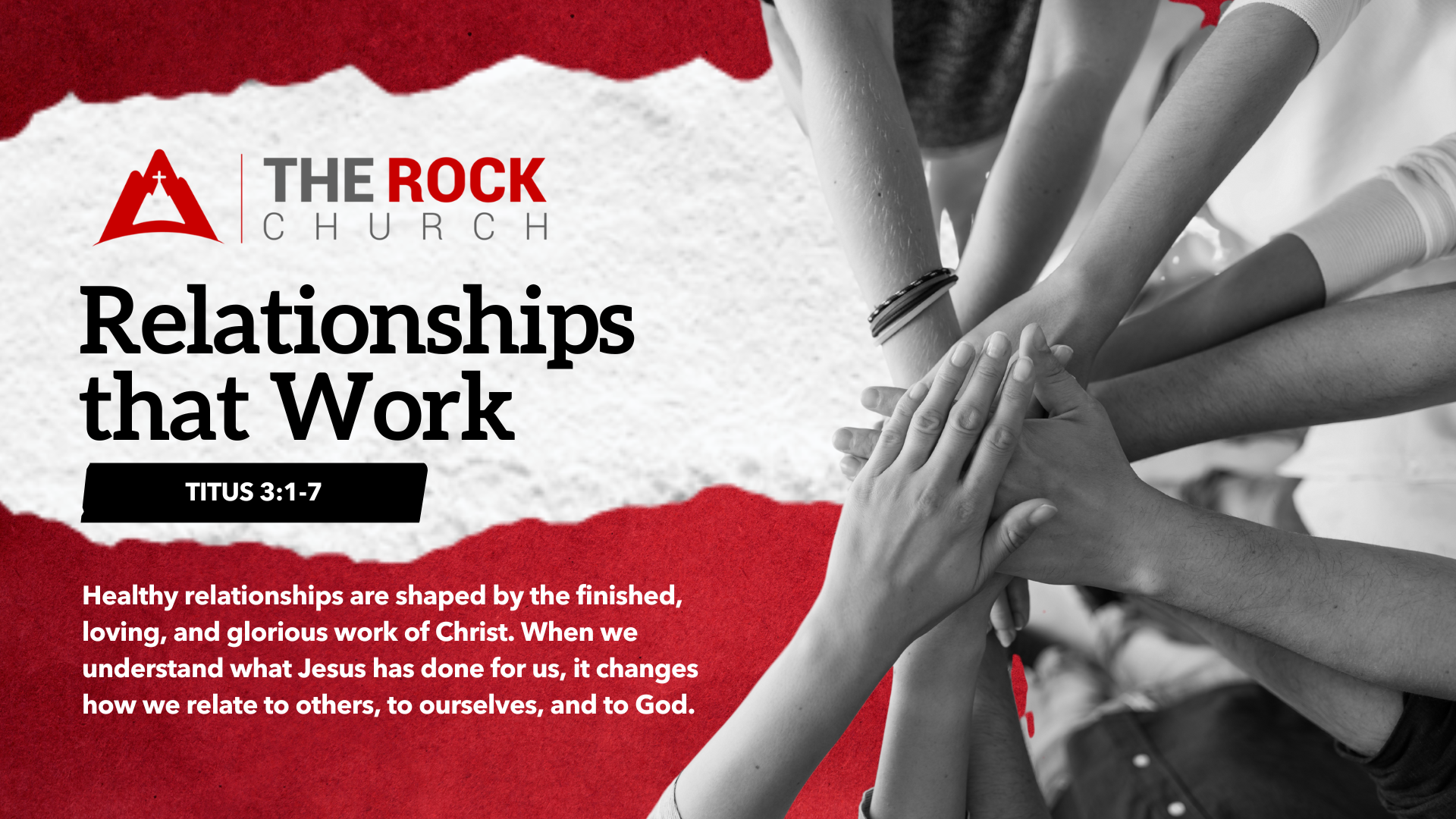
The following is a sermon transcript from our Sunday Service at The Rock Church in Mount Laurel, New Jersey. Each week, we gather to worship, learn from God’s Word, and grow together. This transcript is provided as a free resource to encourage and equip you in your walk with Christ. While you’re welcome to read and share this content for personal use, we kindly ask that it not be redistributed or published elsewhere without prior written consent from The Rock Church.
Introduction: Relationships That Matter Most
I want you to consider for a moment all of your relationships, whether it’s your spouse, your kids, your parents, your boss, your coworkers, your friends, even your neighbors. Which one do you think, of all of those earthly relationships, is the most important?
Well, quite clearly, if you’re married, it’s your spouse. It’s why about half of married couples have sought counseling at some point in their married lives. Endless books have been written on this very subject. In fact, many believing couples often reference the book The Five Love Languages by Gary Chapman. Why? To help them identify what their love language is.
“Oh, I just need that quality time. As long as my spouse gives me that, everything will go well.” For others, it’s words of affirmation, acts of service, gifts, physical touch.
But is it that simple? Is there a formula that we just need to apply and all of our relationships will be healthy? I don’t think so. No.
There are numerous resources available. Take the Love Dare Challenge, 40 days to transform your marriage. And then there’s the 7-Day Marriage Challenge. Apply these simple, actionable steps and you’ll be amazed at the results.
Well, if you’re a Christian, the most important relationship, of course, is with Jesus. And as we seek the Lord, we desire to keep Him center of our marriages, of our work, of our homes, of our neighborhoods.
But it’s not just thinking about who Jesus is, looking to Christ, considering all of His attributes, but it’s also what He has done for you.
This is the work of Christ. This is the depth of His love for you. This is the power of the gospel.
The Central Truth: Christ’s Work Shapes Our Relationships
It’s not just that He lived, died, and rose again. It’s that He did all of that for us. It was His life that was for us. It was His death that was for us. It was His glorious resurrection and ascension to show us His power and authority and ability to transform our lives.
Christ’s work is not just a general offering for everyone with the hope that maybe some would accept. No, it was specific. It was intentional. It was done with your life in mind. He did it for His church, the very ones that He purchased by His own blood. This plan was set up before the foundation of the world.
That’s an incredible reality to meditate upon, that my Savior, my God, would do that for me.
And then it’s only then that we can step back and realize that, you know what, my rights don’t really matter that much. If Christ died for me, then surely I can die to myself and live for the glory of God.
Instead of thinking the worst in others, I can hope the best in them. I can strive to be understanding by the Lord’s help, to be loving, to be helpful, to be seeking to serve rather than be served.
That’s the Christian life. Putting to death myself and living for the Lord who died for me and rose again.
The relationships that work, as the title of the sermon indicates, are those that prioritize the needs of others above self. It’s sacrificial. It’s hard. It’s painful. It’s long-suffering. But thankfully, it’s not forever. Forever.
Overview of the Message
This morning I want to discuss the work that Christ has done for us. It’s the work that He has done, is doing, and will do. This is wonderful. It’s glorious. It’s life transforming. It shapes how we relate to others, to self, to God.
Take note of this central idea:
Christ’s work for us shapes how we properly relate to others, to ourselves, and to God.
Three points:
- The finished work of Christ informs a proper relationship to all authority and to all people.
- The loving work of Christ encourages us to remember our past sins when dealing with the sins of others.
- The glorious work of Christ in the scope of salvation, past, present, and future.
I. The Finished Work of Christ and Our Relationship to Authority and Others
Titus 3:1–2
This morning I want to discuss the work that Christ has done for us. It’s the work that He has done, is doing, and will do. This is wonderful. It’s glorious. It’s life-transforming. It shapes how we relate to others, to self, to God.
Take note of this central idea: Christ’s work for us shapes how we properly relate to others, to ourselves, and to God.
Three points.
First, the finished work of Christ. What does it do? It informs a proper relationship to all authority and to all people.
Second, the loving work of Christ encourages us to remember our past sins when dealing with the sins of others.
And third, the glorious work of Christ in the scope of salvation, the past, the present, and the future.
So we’re looking first at the finished work of Christ, and how it informs a proper relationship to all authority and to all people.
We’re looking at verses 1 and 2. We’ve read them already, but take note. Let’s read together once again. Paul talking to Titus, instructing him as it relates to the church in Crete. And he’s telling him to do this:
“Remind them to be submissive to rulers and authorities, to be obedient, to be ready for every good work, to speak evil of no one, to avoid quarreling, to be gentle, and to show perfect courtesy to all people.”
We’re in trouble here, folks.
It was clear here in the church in Crete — the Cretans, remember them? Lying, lazy, evil gluttons. I love to remind you of who they were. They struggled to relate properly to authority. They struggled with how to relate to society. And it’s not very different from the world in which we live today.
But I want to take a minute to reference a verse from the Old Testament. First Samuel, chapter 15, verse 23. And it says this:
“For rebellion is as the sin of divination,”
or witchcraft, another translation,
“and presumption is as iniquity and idolatry. Because you have rejected the word of the Lord, He has also rejected you from being king.”
Why do I bring this up? What’s the context here?
First Samuel chapter 15. It’s the prophet Samuel speaking to Saul. And he tells him quite clearly, “Saul, guess what? Since you’ve disobeyed the Lord’s command to spare the pagan king and his best livestock, we’ve got some problems. Because of that, you’ll not be able to serve as king.”
Saul is pretty upset about that.
“But Lord, my outward worship is there. I attend church services regularly. I do all the things that You require of me.”
But where is your heart?
That’s the matter at hand.
We can do all the right things and be careful to speak with precision and use all of the Christianese, all of the buzzwords, but our hearts can be far from the Lord. And it’s a danger for us as we walk with the Lord, to end up going through the motions and forget our first love.
I was just reading a book last night. The author was speaking to a young pastor and he said, “Your first priority as a pastor, as a disciple of Christ, is to continue your relationship with Christ.” That’s so important.
It’s so serious that God considers rebellion of the heart to be the same as divination. It’s equivalent to witchcraft.
“Witchcraft, Pastor? That’s some strong language. I’m actually offended by that statement.”
Well, consider what witchcraft is as we look at this verse of rebellion. It’s elevating the will of self above the will of God. And we can quite easily follow after our own will or another spirit without even knowing it.
It’s the pursuit of hidden knowledge or extra-biblical revelation that’s outside of God’s Word. We can easily follow signs and say, “Lord, a butterfly just landed on my shoulder. What are You trying to tell me?” It’s a rainbow. It’s a ladybug. And on and on we go.
Sounds silly. Even ridiculous. But this rebellion is seated deep within our hearts. It’s this constant battle of our flesh’s desire to be God, to rule, to be in control.
And it becomes evident in how we relate to others.
Notice the emphasis here — relating to government, relating to society matters. When it comes to the state, we have to remember that this is an institution created by God.
I know. I know. It doesn’t seem like it.
Romans 13, verse 3:
“For rulers are not a terror to good conduct, but to bad. Would you have no fear of the one who is in authority? Then do what is good, and you will receive his approval.”
So what’s the purpose of government? To promote what is good and to punish what is evil.
Now does that mean that we blindly obey everything the government tells us to do?
Well, of course not.
Acts 5:29 says this:
“But Peter and the apostles answered, ‘We must obey God rather than men.’”
Our primary obedience is to God and to the person and work of Christ. It’s the Lord Jesus that we serve — not Lord Caesar, not Lord President.
But the point is clear. Constant rebellion against authority is equivalent to rebelling against God’s authority.
As Christians, we can spend a lot of time complaining about our governor, our senators, our representatives. And there are legitimate reasons for concern about corruption and injustice. But we are also encouraged to pray for those in authority.
Why?
So that we may lead peaceful and quiet lives.
Just because corruption exists does not mean God cannot change hearts. We pray that those in authority would see their service as ordained by God — to punish evil and protect the innocent.
So what’s the role of the church in relation to government?
Paul tells Titus: remind the church to be ready to do what harmonizes society.
What is this good work in verse one?
It could be helping women in crisis — pregnancy or domestic abuse. It could be caring for children in unstable homes or the foster system. There are countless needs where the church can step in.
Now I’m not saying the church should cozy up to government or compromise biblical values. But if the church is constantly rebelling against God-given authority, it becomes a problem.
The finished work of Christ reveals that Jesus is King.
Amen.
He is the ultimate ruler and authority over all. And we bow the knee before our great God and Savior. And we pray for those in authority. And we engage in good works that reflect the gospel.
And then Paul turns our attention to society at large.
It’s very easy for the church to complain about how wicked the world is. Instead of praying for lost souls, our hearts harden. We vilify people. We widen the divide.
And even worse, sometimes this reviling happens within the church.
Christians attacking Christians. Online. Publicly. For platform and popularity.
Paul says, stop.
Stop the bickering. Stop the fighting. Stop always looking for an argument.
First Peter 2:23 says:
“When He was reviled, He did not revile in return. When He suffered, He did not threaten, but continued entrusting Himself to Him who judges justly.”
Jesus entrusted Himself to God.
Vengeance is mine, says the Lord. I will repay.
But we want to be the judge, the jury, and the executioner.
And so we must fight this tendency. Actively fight it. And seek peace if at all possible.
What if Christians were known for gentleness?
What if we were known as fair and equitable people who treat others as image-bearers of God?
Jesus said:
“Take My yoke upon you and learn from Me, for I am gentle and lowly in heart, and you will find rest for your souls.”
We need rest.
Not physical rest, though we need that too. But spiritual rest.
The yoke of Christ teaches us to trust and obey. It puts to death our rebellious hearts and teaches us to say, “Lord, You are enough.”
The Son of God had all authority, yet He never used it for personal gain. He humbled Himself. He obeyed. He gave Himself.
That gospel reshapes how we view authority and people.
That’s the finished work of Christ forming a proper relationship to all authority and to all people.
II. The Loving Work of Christ: How We Remember Our Former Selves (Titus 3:3)
Paul says, “For we ourselves were once foolish…” Not you—but we. All of us. Even Paul. He reminds us of our past so we can be humble when dealing with the sins of others. Before Christ, our minds were darkened, our wills enslaved, our hearts full of envy and hate.
We were foolish—unable to know the things of the Spirit. We were disobedient—serving self, not God. We were led astray—falling into error, false religion, and endless spirituality centered on self.
We chased money, power, and fame. We thought success would fulfill us. And when that didn’t work, we tore others down just to feel superior. But then—Christ stepped in. And it was not because we sought Him. Paul didn’t choose Jesus; Jesus chose Paul. Just like us, he was born again not by his own will but by the Spirit.
So we show grace. We remember how lost we were. How stubborn. How sinful. And we extend mercy to others—not to condone sin, but to point people to the Savior who saved us.
III. The Glorious Work of Christ: How We Understand Our Salvation (Titus 3:4–7)
“But when the goodness and loving kindness of God our Savior appeared, He saved us…” Not because of anything we did. Not because we were worthy. But because of His mercy.
Salvation is God’s doing. He saved us by the “washing of regeneration and renewal of the Holy Spirit.” Just like the priests who washed before entering the temple, our hearts have been washed clean by the Spirit. Baptism points to this—buried with Christ, raised to new life.
Ezekiel 36:26 foretold it: “I will give you a new heart… a heart of flesh.” That’s what the Holy Spirit does—He regenerates dead hearts. He renovates minds. He sanctifies us by His Word.
This is all of grace. You didn’t earn it. You didn’t initiate it. God made you alive. And now you walk in newness of life.
Paul says we’ve been justified—declared righteous—not just “as if we never sinned,” but actually clothed in Christ’s righteousness. And more than that: we are heirs. Co-heirs with Christ. Adopted into the family. Our inheritance is secure.
So why did He do it? Because of His mercy.
And how? By the washing of the Holy Spirit.
And what is the result? Justification and a secure future as heirs of eternal life.
Closing Exhortation: Christ’s Work Transforms Our Relationships
This gospel truth changes how we live. It changes how we see others—especially those we disagree with. It changes how we speak—especially when we feel wronged. It changes how we love—especially when it’s hard.
If you’ve sinned against someone, ask their forgiveness. Do it today. Be reconciled. We forgive because God forgave us. We love because He first loved us.
Let us now go to Jesus in prayer.
Closing Prayer
O wretched man that I am, who will deliver me from this body of death? But thanks be to God through Jesus Christ, my Lord.
Thanks be to God for your promises that are sure. They never fade away. They never change. Forever fixed. Grass withers, the flowers fade, but the word of the Lord endures forever. Amen.
Oh Lord, our emotions, our suffering, trials, our pain—so much that we face today and some every day. It’s our hope, Lord, that You are coming. You’re going to make all things right.
We may suffer all the way to our last dying breath, but Lord, You are still gracious and good. You never change—the same yesterday, today, and forevermore.
So we place our hope in You today. Our hope in You for our marriages, our children, our neighbors, our bosses, our coworkers, our friends.
We trust that You will shine Your light through us as we walk by faith every day. Do it, Lord.
We want others to glorify God when they see that You’re doing a mighty work in Your church—that we look different, not given to anger and complaints and bitterness and wrath, but gentleness, meekness, joy.
That’s Your Spirit. That’s who we need. Please, Lord, be gracious with us, we pray. In Jesus’ name, Amen.
Ready to Take Your Next Steps at The Rock Church in Mount Laurel?
The Rock Church in Mount Laurel, New Jersey exists to help people know God, follow Jesus, and make disciples who multiply. Whether you’re new or already part of our church family, we’re here to help you stay connected! Plan your visit to experience a Sunday with us, or download the Church Center App to stay updated, join a group, register for events, and more.