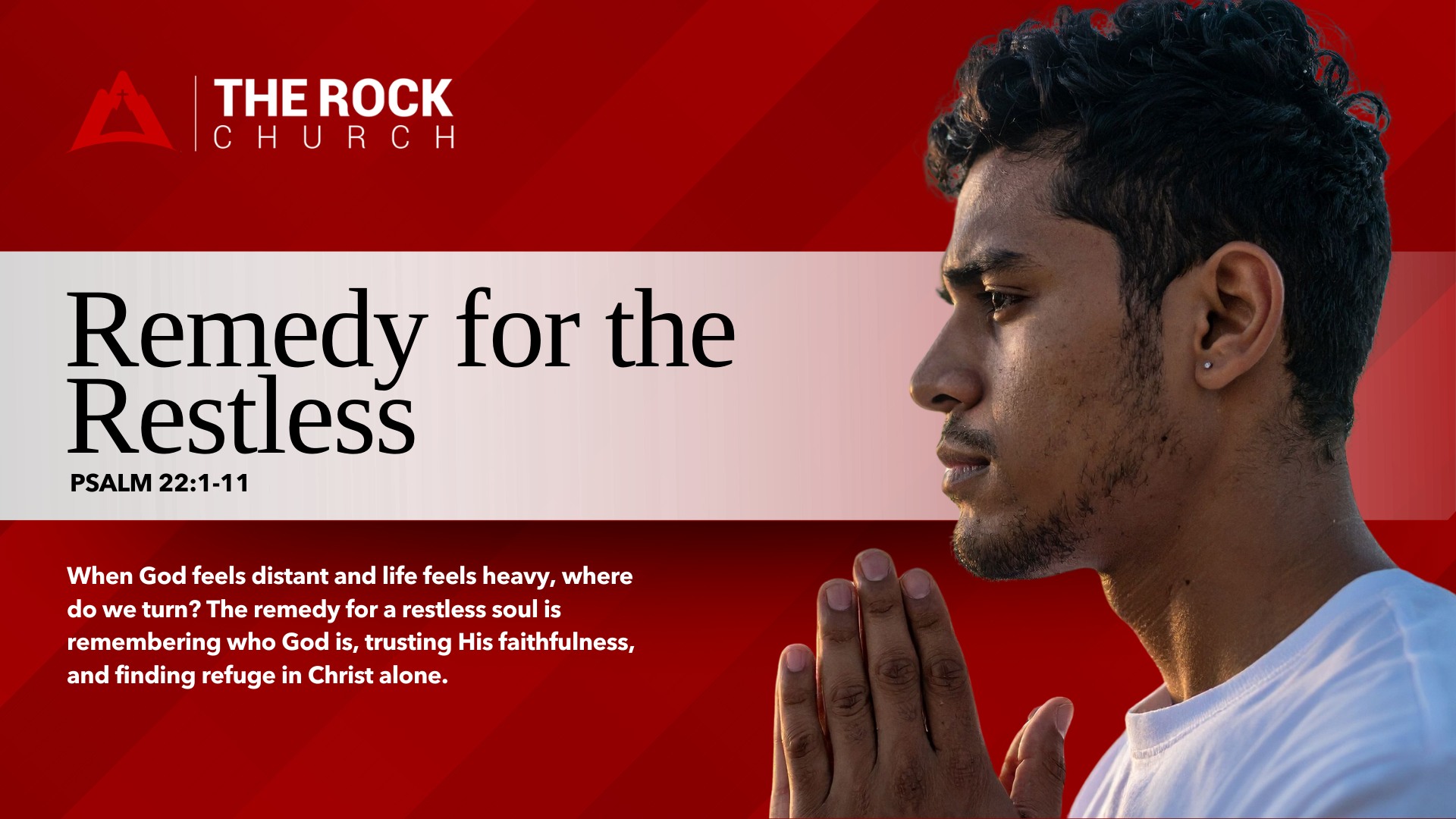
The following is a sermon transcript from our Sunday Service at The Rock Church in Mount Laurel, New Jersey. Each week, we gather to worship, learn from God’s Word, and grow together. This transcript is provided as a free resource to encourage and equip you in your walk with Christ. While you’re welcome to read and share this content for personal use, we kindly ask that it not be redistributed or published elsewhere without prior written consent from The Rock Church.
Introduction
So you’re feeling restless, are you? You know, you’re having trouble being still. Well, of course I am, Pastor. Don’t you realize how long this winter has been? I think Punxsutawney Phil saw a double shadow this year. Believe me, I hear you. It’s the first winter that I remember having this burning desire, Lord, send me to the tropics. Send me to the islands.
So what do I mean by restless? Are you talking about the uneasiness in waiting for spring, or is it something else? The world often tells us to exercise and to eat better, to sleep more. And yet, we’re still restless. But for some of us, it’s this chronic condition. It’s those racing thoughts through your head as you sleep at night. It’s anxiety. It’s depression that just won’t let go of you.
And sometimes the church just says, man, you just got to have more faith. How helpful is that? Where is the empathy? Where is the compassion?
Now, don’t get me wrong. Restlessness can surely be a sign of a deeper spiritual need. If you’re a believer who’s in habitual, ongoing sin, that certainly needs to be addressed. Yet, God is gracious. And His Spirit may leave us restless until a heart issue is resolved.
But what if it isn’t a problem of sin? What if you’re suffering right now through whatever it is—anxiety, depression, or loss—but you’re doing everything right? You’re working hard, serving the Lord faithfully, giving yourself fully to the ordinary means of grace, but these issues remain.
Well, what better book of the Bible than that of the Psalms? It’s rich in worshipful songs of praise. But then there’s also this utter despair. This morning we find ourselves in the section called the Psalms of Lament.
Psalms of Lament? What do you mean by that? Well, this portion is marked by prayers of brokenness and despair. The various authors express their heartfelt pain before a holy God. It’s honest confessions, but it’s also hopeful declarations.
Oh, pastor, why do you have to be such a downer? I was hoping to come to church to feel better, to be more positive.
Well, I understand that. There’s nothing worse than being anxious or depressed. And on top of that, suffering loss—whether it’s someone that you love or something you need, like a job or a relationship. You see, God ordains both seasons of joy and seasons of pain.
But why? Why are they so necessary? I thought the American dream was the pursuit of happiness. And if I don’t get it, I don’t know what I’m going to do.
Well, there, in fact, is the problem. One of expectations. Perhaps we have set our hopes on the things of this world rather than on the living God. And if that’s the case, He will be sure to bring that needed interruption. For me, it’s a clear message. Push pause. Now is the time. My son, slow down. You’re trying to do too many things. These are all good things, but even still too many. Maybe you just need to let the Lord do the work. Stop trying to make it happen.
Yeah, that’s where I am right now. And it’s wonderful.
You see, we’re going to consider this morning King David’s restlessness. We’re going to learn from him. But more importantly, we’re going to learn from King Jesus. That’s right, this is the classic psalm that Jesus even quotes from on the cross. And imagine His restlessness as a human. Forsaken by God, rejected by man, but how could it be that the sinless Savior, the Son of Man, would feel this way?
You see, Jesus asked the Father an important question: My God! My God! Why? Why have you forsaken me? Did you know that there is an answer to that question? And it goes something like this: Because, my son, you have been chosen to stand in the place of guilty sinners.
You see, this is the gospel. This is our hope. This is what we cling to. It’s our confidence.
So let’s consider the point. Here goes: The remedy for a restless soul is found in clinging to Christ.
I want to look at four supporting points here from this central idea:
- Even though God may feel far off, He’s near to the brokenhearted.
- Remembering God’s past faithfulness is the ground for present trust.
- Hatred from the world is the motivation toward pursuing pleasure in the Lord.
- God’s power to preserve us from the beginning will be the same power that we hold on to, to keep us until the end.
Point 1: God May Feel Far Off, but He Is Near to the Brokenhearted
(Psalm 22:1–2)
We’ll look at that first point: Even though God may feel far off, He is near to you. He is near to the brokenhearted.
Psalm 22, verses 1 to 2:
My God, my God, why have you forsaken me? Why are you so far from saving me, from the words of my groaning? O my God, I cry by day, but you don’t answer, and by night, but I find no rest.
Does this describe any of you today? If it does, I want you to know that you’re not alone.
It’s a theme that we find throughout all of Scripture. It’s this issue of rest. All throughout the Word, the people of God are seeking rest. Yet they’re seeking those places of rest in all the wrong places. They’re longing for Messiah, and yet He’s not yet come. Each generation waited patiently. But instead of clinging to the promise of God, they look to rest through their own means.
Often God’s people sought rest in their own ways, like Abraham with Hagar. Can you identify with them? We often seek rest in our jobs, in our careers, in our fulfillment, in our relationships, even churches, but true rest comes only from God.
I remember there was a time when I was juggling my day job, a side business, a family, and a ministry job. There was no rest. I was trying to make things happen. Well, if I just grow the business, I can quit the day job. And if the business grows enough, it’ll support the ministry. None of my plans came to fruition. Zero. God had other plans. He used those difficult times in my life to make me to realize, brother, you don’t make things happen with the Lord. You need to trust the Lord in His timing and in His way.
And what we’re seeing in this text is King David, he’s doing everything right. And yet he cries out to God in his agony. Notice the language here. My God. My God. He says it twice. The Hebrew word is El. It means mighty God. It refers to the one and true only God of Israel. Our God is El Roy—the God who sees.
You see, King David knew who his God was. The question is, do you know who your God is? Have you forgotten so quickly? It’s very easy to do this. All the pressures, all the burdens come crashing down upon you in your life. And what is your natural response? It’s of course to be overwhelmed. And it’s to cry out, my God, I can bear it no more.
Dear believer, even though you’re in that bad place—you think it’s a bad place—I want you to be encouraged this morning because even though God may feel distant from you, He’s quite near to you. In fact, Psalm 51:7 says, the sacrifices of God are a broken spirit, a broken spirit and contrite heart. O God, you will not despise me.
Do you hear that? God will not despise you in your brokenness and contrition. In other words, it’s what the Lord loves. He sees children—not that He loves to see us broken—but He loves to see us in a position where we need Him. And we cry out to Him. And we understand how much we hate sin. How horrific it is. How the corruption that dwells within.
It’s what the authors of the little book called The Valley of Vision—it’s these Puritan prayers—and one of them, the cry of the believer who knows that his sins have been dealt with on the cross, but yet the corruption is still remaining. He can’t quite yet put to death all of the sin that’s within him. This is our struggle. This is our difficulty in this life. Trying over and over. Lord, I know you’ve paid my sins. I know you’ve punished all my sins on the cross. And yet I still deal with these sins. They plague me. This corruption. I can’t let it go.
And that’s why the Apostle Paul would also say, Oh God, who will deliver me from this body of death? But thanks be to God through Jesus Christ our Lord.
Yes, there are times when we’re in so much despair that we feel forsaken by God. We feel abandoned—by the very one who loves us with a love that’s greater than we’ll ever realize.
You see, that’s what David’s expressing here. Abandoned by people is hard. But nothing in comparison to feeling abandoned by God.
You see, what David didn’t know at the time was that he was pointing forward to the one who would be forsaken by God—our Lord Jesus, the one that took all of our sins. You see, David was foreshadowing what would happen on that cross.
It was there that the Son of Man, the eternal Son of God, the God-man, hanging on that cursed tree—and in his humanity He cries out, My God, my God, why have you forsaken me?
Spurgeon illustrates this well in this picture: the Father closed the eye of His love, put down the hand of His justice, and put a smile upon His face. In other words, the Lord was pleased to crush the Son.
But how could it be? How could the Father be pleased to crush the Son? Isaiah 53 verse 10 tells us, Yet it was the will of the Lord to crush Him; He has put Him to grief. When His soul makes an offering for guilt, He shall see His offspring; He shall prolong His days; the will of the Lord shall prosper in His hand.
What good father would be pleased to crush his only son? Only in one way—as that very crushing would accomplish something so great. It pleased the Father because the Son had chosen to stand in the place of guilty sinners like you and me.
The true spiritual rest that the people of God had longed for has come in Christ. The wait is over. The promised Messiah has arrived. The chosen people of God—no longer the rituals, the sacrifices, the hope in an earthly king, the longing for a physical promised land. Christ is the fulfillment. He is the perfect Prophet, Priest, and King. His kingdom has come and now we can run into the arms of the Savior. And we can find rest. We can find mercy in our time of need.
Here David uses these powerful words to express his brokenness. He declares, My God, my God, why are you so far from saving me?
Have you been praying for a spouse? For a family member? For a situation in your life? For your job or your career? And you’ve found no answer? And yet you cry out, How long, O Lord? How long must I travail in prayer?
It’s hard. And there are many times when it feels like, God, do you even hear what I’m saying? Are you even there?
You pray day and night, unceasingly, groaning. These groanings like the roarings of David’s soul. It’s how we respond to pain.
You might ask, I’ve seen this in others who are in pain. And they act irrational and you wonder, what’s wrong with them? But isn’t that what we do? As creatures in pain, yearning for relief but finding none.
Dear believer, God is near to the despairing. Just because you feel abandoned by God does not mean that He has abandoned you.
The Lord is faithful to get our attention in the pain. C.S. Lewis said it well: God whispers to us in our pleasures, He speaks to us in our consciences, but then He shouts to us in our pains. It is His megaphone to rouse a deaf world.
We could be so busy in this life. We’re going from one thing to the next. We hear the whispers of God through His Word, but we’re not listening. And then He speaks to us through His Word. He pricks our conscience. He brings conviction. But it’s not until the pain sets in that we realize: God, now You have my attention.
It may seem odd to say this, but pain is a means of grace in your life. It’s a means of humbling us and reminding us that we are far more dependent upon the Lord than we realize.
Job knew this well. In the Old Testament he declared, The Lord gives and He takes away, but I’m still going to bless His holy name.
You see, it’s very easy to ascribe blame to God for all of our problems: My God, my God, how could You allow this to happen in my life? My God, my God, why is this situation so difficult?
So that we would lift our eyes to the hills and see from whence our help comes from. Our help comes from the Lord, the Maker of heaven and earth. That’s a mighty God. It comes to us through the cross of Christ.
Our help doesn’t come from the things of this world. They are fleeting. They’re always changing. But our God never changes. He is the same yesterday, today, and forevermore. He is our mighty God, our mighty deliverer, our Savior, our helper, our fortress, our strong tower—the only place that we can run to and always be safe.
You see, King David was in a place of restlessness, but he’s also very careful in expressing his honesty that at the same time does not impugn the very character of God.
You see that? That’s crucial.
He reminded himself—even though these emotions are raging, these feelings of God feeling far away, these groanings of prayer, roaring rivers from the soul—he’s wise to speak to his broken and contrite heart. He’s wise to speak to his God, his Savior, his Deliverer, his God.
Remember the situation when Jesus was in the Garden of Gethsemane? Matthew 26—Jesus expresses so much sorrow, even to the point of death. He says, O my Father, if it’s possible, take this cup from Me. Nevertheless, not as I will, but as You will.
The agony of the Savior. The agony of David. Lord, nevertheless, not my will, but Yours be done.
Even though God may feel far off, He is near. He is near to you. He’s shouting through the megaphone of your pain. He’s reminding you He’ll never leave you. He’ll never forsake you.
You see, Jesus was forsaken on the cross so that we wouldn’t have to be. He saved us from a holy God so that we would not be punished hell eternal. He chose to stand in the place of guilty sinners like you and me.
Cling to Christ. Cling to Him in your restlessness. Cry out to the Lord: My God, my God, it feels like You’ve forsaken me. It feels like You’re far from saving me. Lord, I’ve been praying night and day about this situation. There’s no answer. God, I have no rest.
Don’t be afraid to be honest with the Lord. But don’t let that honesty change your perception of who God is. Don’t allow those emotions to alter the reality that God has not forsaken you. That He is going to deliver you. If not in this life, then surely the next.
Healing will come. If not now, then surely in the life to come. It’s God’s promise. And if He said it, we must trust it.
So even though, number one, God may feel far off, He’s near to you. He’s near to the brokenhearted.
Point 2: Remembering God’s Past Faithfulness Is the Ground for Present Trust
(Psalm 22:3–5)
Secondly, remembering God’s past faithfulness is the ground for present trust in verses 3 to 5 of Psalm 22:
Yet you are holy, enthroned on the praises of Israel. In you our fathers trusted; they trusted, and you delivered them. To you they cried and were rescued; in you they trusted and were not put to shame.
You see how the tone changes? You see the shift from verses 1 to 2 to verses 3 to 5?
Yet you are holy. In other words, dear believer, do not despair. God is holy. Don’t lose hope. Don’t be ashamed. Don’t foolishly charge God for all of your troubles. The Lord is holy. He is set apart. There is no one like Him.
Trust in Him. Trust in Him through your pain. Don’t allow your suffering to define what is true about God’s goodness and mercy.
You think that David felt like praising God? You think he felt like coming into the temple, gathering with all the people, shaking some tambourines? No, surely not.
And that many times, even when we don’t feel like praising God, hearing others sing—something happens, doesn’t it? Did you come here today feeling, I don’t really feel like being here today? Don’t raise your hand. But then when you hear the singing, you read the lyrics on the screen, and something happens to your soul. You feel lifted up.
Imagine that this is just a small piece of what is to come. Imagine the kingdom. Imagine heaven, and echoing from Isaiah 6:3, all for the rest of eternity, crying out with all of God’s people:
Holy, holy, holy is the Lord of hosts; the whole earth is full of His glory.
And just keep saying it. Not getting bored. Not getting old. Holy, holy, holy. God, You are high above the heavens, seated on Your throne. You are exalted. Man, I can’t wait. Lord, take me with You. I want to go.
The pain will one day cease and we will be in the presence of the Lamb. What a day it will be.
So Christian, believer, don’t despair. Don’t grow weary or fainthearted. The day of redemption, the day of final deliverance, the day of glorification—when we’re taken out of this body of death and given life, immortal bodies that are incorruptible—it’s nearer now than when we first believed.
Notice verse 4. David now shifts his focus to God’s past faithfulness.
We can be so caught up in our present situation and pain that we have forgotten all of what the Lord has done in our lives. It’s like it didn’t even happen. All we can do is focus squarely on the pain and the circumstance, on the person, on the problem, on the issue—over and over in our heads. It’s milling and milling.
What good is that? What good is that when it takes our attention and focus off all the ways the Lord has been faithful in our lives?
In fact, David was remembering the fathers of the faith. Many of them you know well. Certainly one example is Joseph, delivered from the Egyptian prison, Genesis 21.
And here’s a story from the missionary Hudson Taylor in China. This is mid-1850s or so. Here is a man that faced some hardship, to say the least. At the age of 21, set sail from the British Isles to China.
And at one point during his time on the foreign land, his family was surrounded by a mob of rioters who falsely thought that all the missionaries were kidnapping the children. And so the rioters come upon his home where his wife and kids are, where he’s not present. They start throwing stones and setting the ground on fire. In fact, his wife has to jump out of a second-story building but does not get hurt.
And there was nothing that Hudson could do. All he could do was pray as he observed from a distance. He pleaded with the government officials, “Help them. They’re going to kill my family.” But they refused to help. The government said no.
Hudson turned in a time of prayer and seeking the Lord. And miraculously, they changed their mind. The government official says, “Yeah, we’re going to send soldiers. We’re going to disperse the crowd.” Amazingly, no one in his family was harmed.
Just like the Lord delivered his family, He will deliver you.
How have you seen God faithful in your life? How have you seen Him deliver you out of what was impossible and safely bring you to where you are today? He is faithful.
Do not forget the faithfulness of God in the past. It’s the ground for present trust. It’s what you’ve got to hold on to. Because God was faithful in the past, He will be faithful through your current situation.
He’s reminding you there’s no human effort, no human solution here. You can’t fix this one. You’ve got to leave it in My hands. There’s no strategy or plan that you can craft to get you out of your pain right now.
God, God alone—you are mighty, God. You are mighty to save. You are mighty to deliver. He alone is your help and your strength and your salvation and your song.
Remember how you trusted God in the past? Well, He’s calling you now to trust Him in the present.
Don’t stop crying out to God in your pain. Keep looking to Christ. Keep remembering His faithfulness to send His only Son to die in your place.
Remember the gospel. Remember the power of God unto salvation. And remember, it’s that same power that rose Jesus from the dead working in your life, changing you more and more into the likeness of Christ through your suffering, through your pain.
In the hardest times is when we realize that all we have is Christ. Would you agree? Christ is all you need.
Your health may fail. You may lose your job. Your relationships just are such a mess. Man, Christ is all I have. He’s my rock. He’s my deliverer. The righteous run to Him and are safe.
David recounts how the fathers of the faith trusted God. And they were not put to shame.
Here’s what’s before us today: What have you trusted in that has put you to shame? In other words, what has disappointed you in this life?
It could have been all of your hopes and dreams that were crushed in an instant. And you thought your life was going a certain way. And it hasn’t.
You may be thinking, I thought that once I got saved, once I became a Christian, man, things are going to get better for me. But they haven’t. What’s the deal?
Remember this: keep clinging to Christ.
Does it mean that all your problems go away once you have more of Jesus? Certainly not. But your perspective changes.
Just like David said: Yet you are holy. You see that? He didn’t say, “Yet God, I’m really mad at You.” He said, “Yet God, You are holy. You are enthroned on the praises of Israel. You alone are the unchanging God who rules over all.”
You can identify with Jesus. I’m sure many of you can right now: Father, take this cup of suffering away from me. I’m through. I’m tired. It just won’t stop.
But don’t let that be the end of your prayer. Yet not my will, Lord, but Your will be done.
You keep trusting Christ. You remember His faithfulness in your life, but you also can keep crying out to God. Keep trusting God. Don’t despair. God is holy. He is trustworthy. He is mighty and powerful and will deliver you safely into His kingdom.
As the song goes, O love that will not let me go, I rest my weary soul in Thee.
When you maintain your trust in Christ, you will never be put to shame. Why? Because the love of God has been poured out into your hearts by the Holy Spirit. It’s His love that is keeping you. It’s His electing love, His sovereign love, His love that will never change. Same love that existed before the foundations of the world.
God has chosen you. He has given you eternal life. And you trusted in the person and work of Christ.
So what is the remedy, pastor? Number one, it’s knowing that God is near to you. Secondly, it’s remembering God’s past faithfulness. It’s the ground to your present trust.
Point 3: Hatred From the World Is the Motivation Toward Pursuing Pleasure in the Lord
(Psalm 22:6–8)
Third, it’s the hatred from the world. It’s the motivation toward pursuing pleasure in the Lord. We read some pretty heavy words here, verses 6 to 8, Psalm 22:
But I am a worm and not a man, scorned by mankind, and despised by the people. All who see me mock me; they make mouths at me; they wag their heads. “He trusts in the Lord; let Him deliver him; let Him rescue him, for He delights in him!”
Look at this picture. David thinks of himself as a worm. It’s the lowest. It’s a picture of complete insignificance.
Lord, just put me under the ground where I can just eat away at all that is dead under the ground.
Do you ever feel that way? I’m a worm, man. I’m looking around, I’m doing life, and I’m like, man, I am so insignificant. And yet at the same time, I keep making these mistakes. I don’t feel like I’m a man. I don’t feel like I’m doing my duty as a man. I’m not acting like a man. I’m not being strong and courageous instead of being fearful, lacking in the spiritual leadership God has called me to.
You see, we can honestly pray, Lord, strengthen me, regardless of who you are. It’s crying out to God: Oh Lord, have mercy on me. I feel like a worm. I feel insignificant. Show me Your love. Show me how much You care for me—that You’re mindful of me. That You love me.
See, God’s not surprised by our imperfections. I’ve said it before: God does not despise a broken and contrite heart. It’s a very good thing to be broken sometimes. It’s a very good thing to hate sin. You see, God resists the proud. He gives grace to the humble.
The problem arises when we don’t want to admit our problems. We don’t want to confess our sins. And what happens? We become hardened. We become prideful. And it’s in that place that God resists.
Go ahead. Keep hardening your heart. I’m resisting you until you come to a place where you break down. And it might be a big crash. Don’t let that happen. Don’t let it be a big crash. Let it be a consistent humility—to stay low, to find that remedy for the restless soul in Christ.
See, David finds himself in a very difficult situation. How’s that? Everyone around him has forsaken him. That’s a really tough spot to be in.
When the world is hurling insults at you—What’s wrong with you? I don’t understand you—remember what Jesus said: Remember, if the world hates you, keep in mind it hated Me first.
It’s to be expected to be hated by the world, because we’re not citizens of the world. The world mocks us for living differently, and it hurts because we long for acceptance.
This recent story that I read of this Lena Savichuk, who grew up as a Christian in the Soviet Union—a nation certainly dedicated to atheism. You can probably guess what her experience was like. She was mocked. She was ridiculed by her schoolmates. They even threw things at her. “Christian? There is no God.”
And she would walk through some very hard teenage years, even questioning her faith, even wrestling with what she believed. She came back, and today she’s a pastor’s wife. She shares her story as a means of grace for others to persevere in whatever way the world is treating you.
Keep going in the face of adversity. Just like God was faithful to preserve Lena, He will be faithful to preserve you.
Imagine, though, the sinless Savior on the cross. Here He is, the spotless Lamb of God, and everyone is hurling insults at Him, insulting Him, saying to Jesus: So You think You’re God? Take Yourself down from that cross. You have all power and authority—why don’t You just use it already?
And they mocked the Savior. They tore His garments. They spat upon Him. They beat Him. They shook their heads. They stuck out their tongues.
But notice—notice further how David shifts here in verse 8. He’s quoting now from both Psalm 37:5 and Proverbs 16:3. You’re probably aware of both of these phrases. They begin with the phrase, Commit yourself to the Lord and end with two variations.
The one says: He will act.
And the second: Your plans will be established.
Commit yourself to the Lord and He will act. He will establish your plans. That sounds wonderful.
Now, that phrase commit, or trust, in the Hebrew—it literally means to take the burdens—I’m telling you, this is the size of the stone—and roll it onto the Lord. Go ahead. Roll it onto the Lord. That’s what it means to commit: roll your burdens onto Him.
You know the story of Sisyphus—that Greek mythology? The king who has tried to outsmart the gods, and as a punishment, he was forced to do what? Roll that stone up that hill. Go ahead, roll it up. He’s like, “Alright, I’m getting to the top, I’m almost there.” Oh—sorry—too bad. Knocks it back down. And on and on for all eternity. Roll up the stone. Roll it back down. On and on.
It’s a reminder of the futility of life apart from God. How clever we think we are—striving without Him can feel endless and meaningless.
But unlike this Greek god, with our God, we can find purpose and rest and lasting fulfillment.
You see, with our Lord, we can roll the heavy stones of our burdens—He’s going to take them. But guess what? He’s not going to roll them back at you. He’s not going to say, “Yeah, I’ll take them for a little while, but now it’s time for you to take back the burden.” No, He doesn’t do that. He lifts us up.
And this is, in fact, what we use the hatred from the world to motivate us toward pursuing pleasure in the Lord. You see that in the last part of verse 8: For He delights in Him.
In other words, something powerful happens when we delight ourselves in the Lord. Scripture tells us that He will give us the desires of our hearts.
What are those desires? New car? Bigger house? Greater pleasure? No. He’ll give us more of Him. More of His presence. More of all of His goodness.
You know, you could be walking through this storm or trial, the Lord gives you a special gift of His presence. Has that ever happened to you? A very, very low spot—really, really difficult—and the Lord comes and is present with you. How powerful it is.
How powerful when the world hates you, mocks you for being a Christian, treats you terribly—you can come into God’s presence with God’s people and find delight. That’s powerful.
Don’t get bitter when you’re rejected or mocked. Let that very thing motivate you toward pursuing pleasure in the Lord. Let that drive you to delight yourself in the Lord and He will give you the desires of your heart.
Remember the scorn that Jesus endured. Never forget the cross and know that the rejection you’re experiencing is what Christ went through—but even more.
So we’ve learned a few lessons for the remedy for a restless soul. We’ve learned that God is near to us in our brokenness. He’s faithful in the past. He’ll be faithful to us now. That hatred from the world is the motivation to pursuing pleasure in the Lord.
And lastly…
Point 4: God’s Power to Preserve From the Beginning Is the Promise to Hold On to the End
(Psalm 22:9–11)
And lastly, God’s power to preserve from the beginning is the promise to hold on to the end. So last section here, verses 9 to 11:
Yet you are He who took me from the womb; You made me trust at my mother’s breasts. On You was I cast from my birth, and from my mother’s womb You have been my God. Be not far from me, for trouble is near, and there is none to help.
Doesn’t this seem like an odd thing? Here you are going through all of your suffering, all of your pain, and you start thinking about, “Oh yeah, what was it like when I was born?” Why would David do that?
Well, that’s an interesting question. But the lesson here is that certainly a baby is completely helpless. David says, Lord, You made me trust in You. You see, it’s a picture of the life of a believer.
If we’re truly honest with ourselves, we would realize that we are completely dependent on the Lord. But what happens when we understand that it is in the Lord that we live and move and have our being? It’s Christ who upholds the whole universe and is upholding your very existence right now. It certainly changes how we think about our lives.
David’s not complaining here. He’s not saying, “Lord, You made me trust in You. I don’t like being fed by my mother in that way, but You made me do it.” No.
Being helpless is a freeing thing. It’s freeing in the sense that we realize everything that is good in our lives is from the Lord.
We think that it’s our mothers who brought us out of the womb, but it isn’t. It was the hand of the Lord that drew us out. He brought us into the world. And if He can do that, won’t He also safely bring us into His kingdom?
God doesn’t become our God when we’re born again. He is our God. Period. He is our God. He is the God of the living. He is the One for whom every knee will bow and every tongue confess.
So know that since God has preserved us from the beginning, surely He’s going to preserve us to the end.
This is the preserving power of God—that He’ll never leave us. That He’ll never forsake us. That no one can snatch us out of the palm of His hand. And nothing can separate us from His love—neither the pain that you’re in right now, nor the sorrow, nor the tragedy or depression or anxiety.
It’s the Lord’s love. Keeps us. Preserves us. All the way into His kingdom and glory.
When hardship comes, we have no one to turn to but the Lord. We turn to the Lord. We remind ourselves who is our God. He’s the maker of heaven and earth. He’s the exalted Son of God. He sits at the right hand of the Father. He is our great High Priest who forever makes intercession for us. Never, ever grows weary.
He’s for us. He’s our God, our Savior, our friend. He understands us better than anyone. In fact, He knows us better than we know ourselves.
What a great comfort to a restless soul. What a great remedy to a weary heart.
You have not been abandoned by your God. He has kept you from birth and has been your God. He will rescue you from every evil. He will safely deliver you into His kingdom.
Isn’t it wonderful how David is able to be honest with God while at the same time not forgetting who God is?
Don’t forget about who your God is. Don’t forget all the wonderful ways that He’s delivered you and will deliver you from this body of death.
You see, death for the believer no longer has a sting. Why? It’s been swallowed up in the victory of Christ, who rules over all. Hold on to that. Hold on to God’s power to preserve you until the end. And be assured of this: You will never be put to shame.
Closing Exhortation
So as we close, I hope you are encouraged by God’s faithfulness. I hope that the Lord caused faith to rise up in your heart, to cause a greater trust in Him rather than you making your circumstances better. I hope that you realize you can be honest with the Lord in your pain.
You see, we all suffer in varying ways and to varying degrees. But let it never stop us from looking to Christ so that we can find that remedy for our restlessness.
We’re going to take a few moments now before the Lord. Let it be a sweet time for you. Some of you are like, “Man, things have been going pretty well for me. It’s not really for me. Sorry.” But for a lot of you, you’ve been through a season that’s caused you to grow weary. I don’t know how long that season has been or will be, but now’s the time to cry out to the Lord in lament, in weeping, in honesty, in pleading with the Lord.
Tell Him, “My God, my God, this is how I feel. Yet, Lord, I trust You. I trust You. I trust You because You’re holy. I trust You because You’re faithful. I trust You because You have all power and authority over my life.”
So let’s do that now. Just take a moment. If you’re in that season, just cry out to the Lord. Whatever it is—spouse, family, work, loss—cry out to the Lord and meet with Him, and I’ll pray as we prepare to come to the Lord’s table.
Pastoral Prayer
Our God, we come to You. Our God, we come in our brokenness. We come to You in our pain. And we pray that You would be our God—the God that You always have been. But in a very special way, Jesus, You would continue to reveal Yourself to us. You would open the eyes of our understanding. Our hearts would be able to receive from You.
We would trust that You are holy. You are enthroned on the praises of Israel. You are the One that we worship, that we bow before. You are the Creator and the sustainer of all things. Who is like You, Lord? There’s no one.
So remind us of who You are. We need to know who You are—for each of us. We need Your encouragement because we’re tired and we’re weary. And there seems to be no answer.
Yet You are holy. And so we make that cry. Just as the fathers of the faith trusted in You and were delivered, we trust in You. We trust that You have been faithful and will be faithful. And whatever season that we’re in, You will safely see us through—whatever it is.
May we not forget that reality. You are good and holy and just and true. Oh God, change our hearts. Comfort us in our affliction. Be the God of all mercy to us now as we pray. In Jesus’ name, amen.
Ready to Take Your Next Steps at The Rock Church in Mount Laurel?
The Rock Church in Mount Laurel, New Jersey exists to help people know God, follow Jesus, and make disciples who multiply. Whether you’re new or already part of our church family, we’re here to help you stay connected! Plan your visit to experience a Sunday with us, or download the Church Center App to stay updated, join a group, register for events, and more.