Who We Are
MISSION
The Rock Church of South Jersey exist to glorify God by holding out Christ to weary sinners.
VISION
Our vision is to see Christ glorified through faithful, confessional churches that proclaim His gospel among every people.
CORE VALUES
God’s Word As our Highest Authority
Dependency on God in Prayer
Outreach in Jesus Name
Authentic Community
Lifestyle of Worship
Intentional Discipleship
STRATEGY
We Help People Know God
Primarily through our weekend worship service and outreach to the community.
We Help People to Follow Jesus
By doing life together and being part of a small group.
We Help People to Make Disciples
By intentionally investing in the lives of one another with the Word of God and prayer.
We Help People Multiply Disciples
By sending out church planters and missionaries.

THE PASTOR'S CALLING
Ben Honeyford recalls in 2006 when he first learned about church planting, this movement of new churches being born out of a desire to reach this generation in a meaningful way with the gospel of Jesus Christ. Then, in 2009, he sensed a desire to plant in Camden, NJ. He moved his family back to South Jersey, where he grew up and began a Bible study which became weekly church services and regular outreaches. After that season came to a close, he realized he needed more training and development. Ben spent some time as a ministry resident with a church plant in Gloucester City and then as youth minister with a church in Mount Laurel. In January of 2020, Ben and his wife Angelica were assessed by the Eastern District Association (EDA) of the Evangelical Free Church of America (EFCA). The EDA affirmed the call on his life and Pastor Ben was also licensed with the EFCA in 2020. He and his family are elated to serve in a church that is in the community for the community.
LEADERS

Ben Honeyford
Lead Pastor
Pastor Ben grew up in South Jersey in the small town of Riverton. He attended Palmyra High School, as well as receiving his degree in business from Temple University. He has a certificate in biblical studies with a focus on pastoral ministry from Calvary Chapel Bible Institute in Fort Lauderdale, FL. He also worked for Calvary Chapel Fort Lauderdale as a facilities manager. He started Calvary Fellowship of Camden and was a youth minister in a local church, before planting The Rock Church. He also ran a commercial cleaning company for five years and worked in employee benefits consulting for ten years. Pastor Ben is so pleased to serve full time as pastor of The Rock Church of South Jersey. He is married to Angelica and has three girls. He is currently pursuing a Masters of Arts in Theological Studies from Westminster Theological Seminary.

Ralph Roesler
Elder
Ralph had the great joy of growing up in the church surrounded by both believing parents and grandparents. It was instilled in him from a very young age to serve the church. Ralph is married to Judy and has two children. He has served in a number of churches and has experience in different church polity. Ralph has a burden for prayer and care. He enjoys praying for the church and visiting those in need, whether at home or the hospital. Ralph is a long time native of South Jersey, who attended Pennsauken High School and Pfieffer College in North Carolina.

Duncan Catlett
Elder
Duncan is from Leawood, KS and lived mostly in the midwest. He attended the University of Kansas and earned his bachelor’s degree in Business Administration. Duncan also has a Master’s degree from Liberty University in Management and Leadership. After college, he was commissioned into the United States Air Force where his primary duty was mobility pilot/instructor pilot for 10 years. Duncan, his wife, and 4 children live in Mt Laurel, New Jersey. His spiritual calling includes leadership, teaching and counseling in the body of Christ.

Michael Stocklin
Worship Leader
Michael Stocklin has been leading worship for over 22 years and is employed full-time as a Director of IT for a regional bank based in New Jersey. Michael, his wife Brenda, and their five children live in Voorhees, New Jersey. Michael served at Cornerstone Church in Mt. Laurel, for over 14 years. Before that, he served at Immanuel Baptist Church in Maple Shade.
Jesse DeSanto
Deacon of Safety & Security
Treasurer
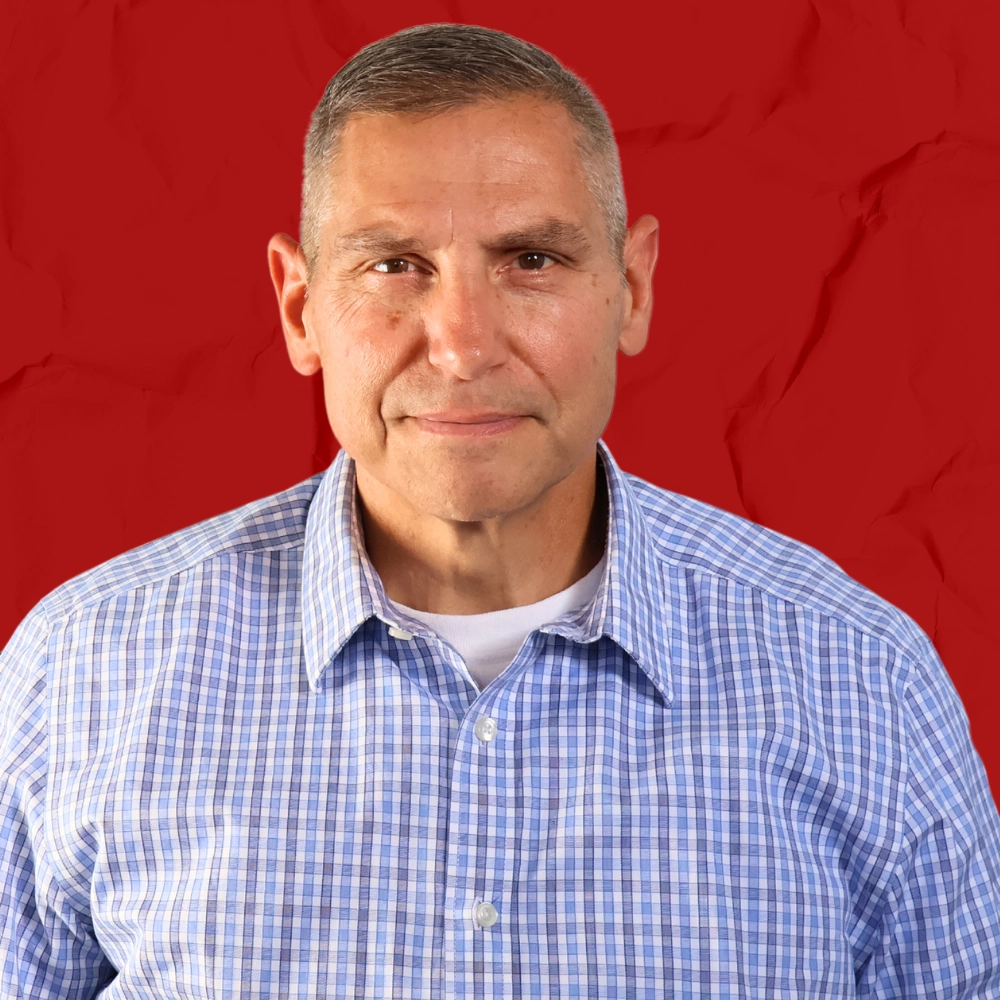
Jesse is a lifelong resident of Burlington County, NJ. He grew up in Riverside, where he attended Riverside High School before graduating from Burlington County College with an Associate’s Degree in Criminal Justice. After marrying Pam, his wife of 33 years, they moved to Delanco, where they still live. Jesse entered law enforcement and served as a police officer for 33 years, retiring as the Chief of Police for Delanco Township in January 2022. Jesse grew up in a family that knew the gospel, and he rededicated his life to Christ when he joined the Rock Church in 2021. He serves in the church in various capacities with the desire to become more Christ-like each day while uplifting and encouraging others to do the same.

Chuck Lovett, Sr.
Deacon of Facilities
Chuck has been a lifelong resident of Burlington County and has called Mount Holly, NJ, home since 1978. His journey of faith began in childhood when he accepted Christ through a “Good News Club” ministry that his family hosted one summer in Pemberton, NJ. In 1992, he rededicated his life to Christ and was baptized upon joining Calvary Bible Church. With over 40 years of experience in the fluid power industry, Chuck is a sales manager for a leading distributor in Northern New Jersey. He and his wife, Sue, have been happily married for over 30 years and are proud parents of two sons.

Damian Zurek
Deacon of Special Projects
& Support
Damian was born and raised in Poland, where he pursued studies in both European law and civil engineering. At the age of 20, he made his first journey to the United States, a place he would continue to visit regularly to see his family. In 2015, he made the life-changing decision to settle permanently in the U.S. It was during this time that he got married and was blessed with two daughters. However, the most profound transformation in his life came when he found God. Since nearly the inception of our church, Damian has been a devoted and humble servant, joyfully dedicating himself to both the church and its people. His faith, commitment, and willingness to serve have been a true blessing to our community.

Tina Boone
Financial Secretary
STATEMENT OF FAITH
God
We believe in one God, Creator of all things, holy, infinitely perfect, and eternally existing in a loving unity of three equally divine Persons: The Father, the Son and the Holy Spirit. Having limitless knowledge and sovereign power, God has graciously purposed from eternity to redeem a people for Himself and to make all things new for His own glory.
The Bible
We believe that God has spoken in the Scriptures, both Old and New Testaments, through the words of human authors. As the verbally inspired Word of God, the Bible is without error in the original writings, the complete revelation of His will for salvation, and the ultimate authority by which every realm of human knowledge and endeavor should be judged. Therefore, it is to be believed in all that it teaches, obeyed in all that it requires, and trusted in all that it promises.
The Human Condition
We believe that God created Adam and Eve in His image, but they sinned when tempted by Satan. In union with Adam, human beings are sinners by nature and by choice, alienated from God, and under His wrath. Only through God’s saving work in Jesus Christ can we be rescued, reconciled and renewed.
Jesus Christ
We believe that Jesus Christ is God incarnate, fully God and fully man, one Person in two natures. Jesus—Israel’s promised Messiah—was conceived through the Holy Spirit and born of the virgin Mary. He lived a sinless life, was crucified under Pontius Pilate, arose bodily from the dead, ascended into heaven and sits at the right hand of God the Father as our High Priest and Advocate.
The Work of Christ
We believe that Jesus Christ, as our representative and substitute, shed His blood on the cross as the perfect, all-sufficient sacrifice for our sins. His atoning death and victorious resurrection constitute the only ground for salvation.
The Holy Spirit
We believe that the Holy Spirit, in all that He does, glorifies the Lord Jesus Christ. He convicts the world of its guilt. He regenerates sinners, and in Him they are baptized into union with Christ and adopted as heirs in the family of God. He also indwells, illuminates, guides, equips and empowers believers for Christ-like living and service.
The Church
We believe that the true church comprises all who have been justified by God’s grace through faith alone in Christ alone. They are united by the Holy Spirit in the body of Christ, of which He is the Head. The true church is manifest in local churches, whose membership should be composed only of believers. The Lord Jesus mandated two ordinances, baptism and the Lord’s Supper, which visibly and tangibly express the gospel. Though they are not the means of salvation, when celebrated by the church in genuine faith, these ordinances confirm and nourish the believer.
Christian Living
We believe that God’s justifying grace must not be separated from His sanctifying power and purpose. God commands us to love Him supremely and others sacrificially, and to live out our faith with care for one another, compassion toward the poor and justice for the oppressed. With God’s Word, the Spirit’s power, and fervent prayer in Christ’s name, we are to combat the spiritual forces of evil. In obedience to Christ’s commission, we are to make disciples among all people, always bearing witness to the gospel in word and deed.
Christ's Return
We believe in the personal, bodily and glorious return of our Lord Jesus Christ. The coming of Christ, at a time known only to God, demands constant expectancy and, as our blessed hope, motivates the believer to godly living, sacrificial service and energetic mission.
Response and Eternal Destiny
We believe that God commands everyone everywhere to believe the gospel by turning to Him in repentance and receiving the Lord Jesus Christ. We believe that God will raise the dead bodily and judge the world, assigning the unbeliever to condemnation and eternal conscious punishment and the believer to eternal blessedness and joy with the Lord in the new heaven and the new earth, to the praise of His glorious grace. Amen.
Our Confession
The Church’s final and ultimate authority is the Word of God. There are, however, explanations of biblical doctrine which have served the church throughout its history. The classic and Reformed confessions/creeds of the church have been born out of moments of much-needed clarity. They have also helped the church define orthodoxy, informed its worship, and provided it with a trusted exposition of the gospel of Christ.
While they are not inspired or authoritative, they are helpful. We, as elders of The Rock Church, have affirmed the 1689 Second London Baptist Confession in order to assist us in our pursuit of Reformed orthodoxy. While affirming this confession is not required for membership, we have found it useful to provide clarity where our statement of faith does not.
CREEDS
From the Latin word credo, which simply means “I believe.”
Throughout history, Christian creeds and confessions of faith have served to help the church of Jesus Christ stand firm on the Word of God. This collection includes several historic creeds and confessions, along with commentary that conveys the importance of these timeless statements for Christians today. The church has never been without a confession or creed.
Christians have always written and cherished summaries of their beliefs. The Bible records the earliest of these confessions of faith (1 Tim 3:16). Then, the early post-Apostolic church produced definitive statements of essential Christian belief, such as the Apostles’ Creed and the Nicene Creed, still considered benchmarks of orthodoxy. In the centuries that have followed, Christians have continued to produce confessions: the Augsburg Confession (1530), the Thirty-Nine Articles (1562), the Westminster Confession of Faith (1646), the London Baptist Confession of Faith (1689), and so on. The church has never been without a confession or creed.
Apostles' Creed
This creed is called the Apostles’ Creed not because it was produced by the apostles themselves but because it contains a brief summary of their teachings. It sets forth their doctrine “in sublime simplicity, in unsurpassable brevity, in beautiful order, and with liturgical solemnity.” In its present form it is dated no later than the fourth century. More than any other Christian creed, it may justly be called an ecumenical symbol of faith.
I believe in God, the Father almighty, creator of heaven and earth.
I believe in Jesus Christ, his only Son, our Lord, who was conceived by the Holy Spirit and born of the virgin Mary.
He suffered under Pontius Pilate, was crucified, died, and was buried; he descended to hell.*
The third day he rose again from the dead. He ascended to heaven and is seated at the right hand of God the Father almighty. From there he will come to judge the living and the dead.
I believe in the Holy Spirit, the holy catholic** church, the communion of saints, the forgiveness of sins, the resurrection of the body, and the life everlasting. Amen.
* The statement “he descended into hell” uses the Greek word “Hades.”
The word Hades, in Greek, refers to the state of death. It could be translated as “descended to those below.” It does not refer to the place we recognize today as hell—it refers to the physical state of death.
** “The holy catholic church” is a phrase that refers to the wholeness of the whole church in all times and places not the Roman Catholic Church. The term “catholic” comes from two Greek words that mean “throughout the whole”.
Athanasian Creed
Quicumque vult—this phrase is the title attributed to what is popularly known as the Athanasian Creed. It was often called the Athanasian Creed because for centuries people attributed its authorship to Athanasius, the great champion of Trinitarian orthodoxy during the crisis of the heresy of Arianism that erupted in the fourth century. That theological crisis focused on the nature of Christ and culminated in the Nicene Creed in 325. At the Council of Nicea of that year the term homoousios was the controversial word that finally was linked to the church’s confession of the person of Christ. With this word the church declared that the second person of the Trinity has the same substance or essence as the Father, thereby affirming that the Father, the Son, and the Holy Spirit are equal in being and eternality. Though Athanasius did not write the Nicene Creed, he was its chief champion against the heretics who followed after Arius, who argued that Christ was an exalted creature but that He was less than God.
We worship one God in trinity and the trinity in unity, neither blending their persons nor dividing their essence.
For the person of the Father is a distinct person, the person of the Son is another, and that of the Holy Spirit still another. But the divinity of the Father, Son, and Holy Spirit is one, their glory equal, their majesty coeternal.
What quality the Father has, the Son has, and the Holy Spirit has.
The Father is uncreated, the Son is uncreated, the Holy Spirit is uncreated. The Father is immeasurable, the Son is immeasurable, the Holy Spirit is immeasurable. The Father is eternal, the Son is eternal, the Holy Spirit is eternal. And yet there are not three eternal beings; there is but one eternal being. So too there are not three uncreated or immeasurable beings; there is but one uncreated and immeasurable being.
Similarly, the Father is almighty, the Son is almighty, the Holy Spirit is almighty. Yet there are not three almighty beings; there is but one almighty being. Thus the Father is God, the Son is God, the Holy Spirit is God. Yet there are not three gods; there is but one God. Thus the Father is Lord, the Son is Lord, the Holy Spirit is Lord. Yet there are not three lords; there is but one Lord.
The Father was neither made nor created nor begotten from anyone.
The Son was neither made nor created; he was begotten from the Father alone. The Holy Spirit was neither made nor created nor begotten; he proceeds from the Father and the Son. Accordingly there is one Father, not three fathers; there is one Son, not three sons; there is one Holy Spirit, not three holy spirits. Nothing in this trinity is before or after, nothing is greater or smaller; in their entirety the three persons are coeternal and coequal with each other. So in everything, as was said earlier, we must worship their trinity in their unity and their unity in their trinity.
Anyone then who desires to be saved should think thus about the trinity. But it is necessary for eternal salvation that one also believe in the incarnation of our Lord Jesus Christ faithfully.
Now this is the true faith:
That we believe and confess that our Lord Jesus Christ, God’s Son, is both God and human, equally. He is God from the essence of the Father, begotten before time; and he is human from the essence of his mother, born in time; completely God, completely human, with a rational soul and human flesh; equal to the Father as regards divinity, less than the Father as regards humanity. Although he is God and human, yet Christ is not two, but one. He is one, however, not by his divinity being turned into flesh, but by God’s taking humanity to himself. He is one, certainly not by the blending of his essence, but by the unity of his person. For just as one human is both rational soul and flesh, so too the one Christ is both God and human. He suffered for our salvation; he descended to hell; he arose from the dead; he ascended to heaven; he is seated at the Father’s right hand; from there he will come to judge the living and the dead.
The Nicene Creed (381 AD)
The Nicene Creed, also called the Nicaeno-Constantinopolitan Creed, is a statement of the orthodox faith of the early Christian church in opposition to certain heresies, especially Arianism. These heresies, which disturbed the church during the fourth century, concerned the doctrine of the trinity and of the person of Christ. Both the Greek (Eastern) and the Latin (Western) church held this creed in honor, though with one important difference: the Western church insisted on the inclusion of the phrase “and the Son” (known as the “filioque”) in the article on the procession of the Holy Spirit; this phrase still is repudiated by the Eastern Orthodox church. In its present form this creed goes back partially to the Council of Nicea (A.D. 325) with additions by the Council of Constantinople (A.D. 381). It was accepted in its present form at the Council of Chalcedon in 451, but the “filioque” phrase was not added until 589. However, the creed is in substance an accurate and majestic formulation of the Nicene faith.
We believe in one God the Father almighty maker of heaven and earth, of all things visible and invisible. and in one Lord Jesus Christ, the only Son of God, begotten from the Father
before all ages, God from God, Light from Light, true God from true God, begotten, not made; of the same essence as the Father. Through him all things were made. For us and for our salvation he came down from heaven; he became incarnate by the Holy Spirit and the virgin Mary, and was made human.
He was crucified for us under Pontius Pilate; he suffered and was buried. The third day he rose again, according to the Scriptures. He ascended to heaven and is seated at the right hand of the Father. He will come again with glory to judge the living and the dead. His kingdom will never end.
And we believe in the Holy Spirit, the Lord, the giver of life. He proceeds from the Father and the Son, and with the Father and the Son is worshiped and glorified. He spoke through the prophets.
The Chalcedonian Creed (451 AD)
The Chalcedonian Creed, also known as the Chalcedonian Definition or the Definition of Chalcedon, was adopted in 451 AD at the Council of Chalcedon in Asia Minor. The creed was a response to heretical views about the nature of Christ, such as Apollinarianism, Nestorianism, and Eutychianism. The creed states that Jesus Christ is both fully God and fully man, and is recognized in two natures without confusion, change, division, or separation.
We, then, following the holy Fathers, all with one consent, teach men to confess one and the same Son, our Lord Jesus Christ, the same perfect in Godhead and also perfect in manhood; truly God and truly man, of a reasonable (rational) soul and body; consubstantial (coessential) with the Father according to the Godhead, and consubstantial with us according to the Manhood; in all things like unto us, without sin; begotten before all ages of the Father according to the Godhead, and in these latter days, for us and for our salvation, born of the Virgin Mary, the Mother of God, according to the Manhood; one and the same Christ, Son, Lord, Only-begotten, to be acknowledged in two natures, inconfusedly, unchangeably, indivisibly, inseparably; the distinction of natures being by no means taken away by the union, but rather of the property of each nature being preserved, and concurring in one Person and one Subsistence, not parted or divided into two persons, but one and the same Son, and only begotten, God, the Word the Lord Jesus Christ; as the prophets from the beginning (have declared) concerning him, and the Lord Jesus Christ himself has taught us, and the Creed of the holy Fathers has handed down to us.
STATEMENTS
Historically, churches have found it necessary, given the cultural moment, to craft statements that make clear what the Bible says about certain issues. We find ourselves in a cultural moment that demands we make clear what the Bible says about itself, gender, and sexuality, and so we affirm the following statements as guiderails not equal to the Word of God.
AFFILIATION
The Rock Church of South Jersey is part of the Grace Reformed Network. GRN is an association of confessional churches united around the sufficiency of Christ. We are historical, confessional, and covenantal. We are committed to the primacy of the local church. We believe the ordinary means of grace are how God primarily grows, sustains, and protects local congregations. We believe peace, rest, and security for sinners only come through union with Christ by faith. We understand the focus of the local church is the salvation of God’s people and the building up of the body of Christ.