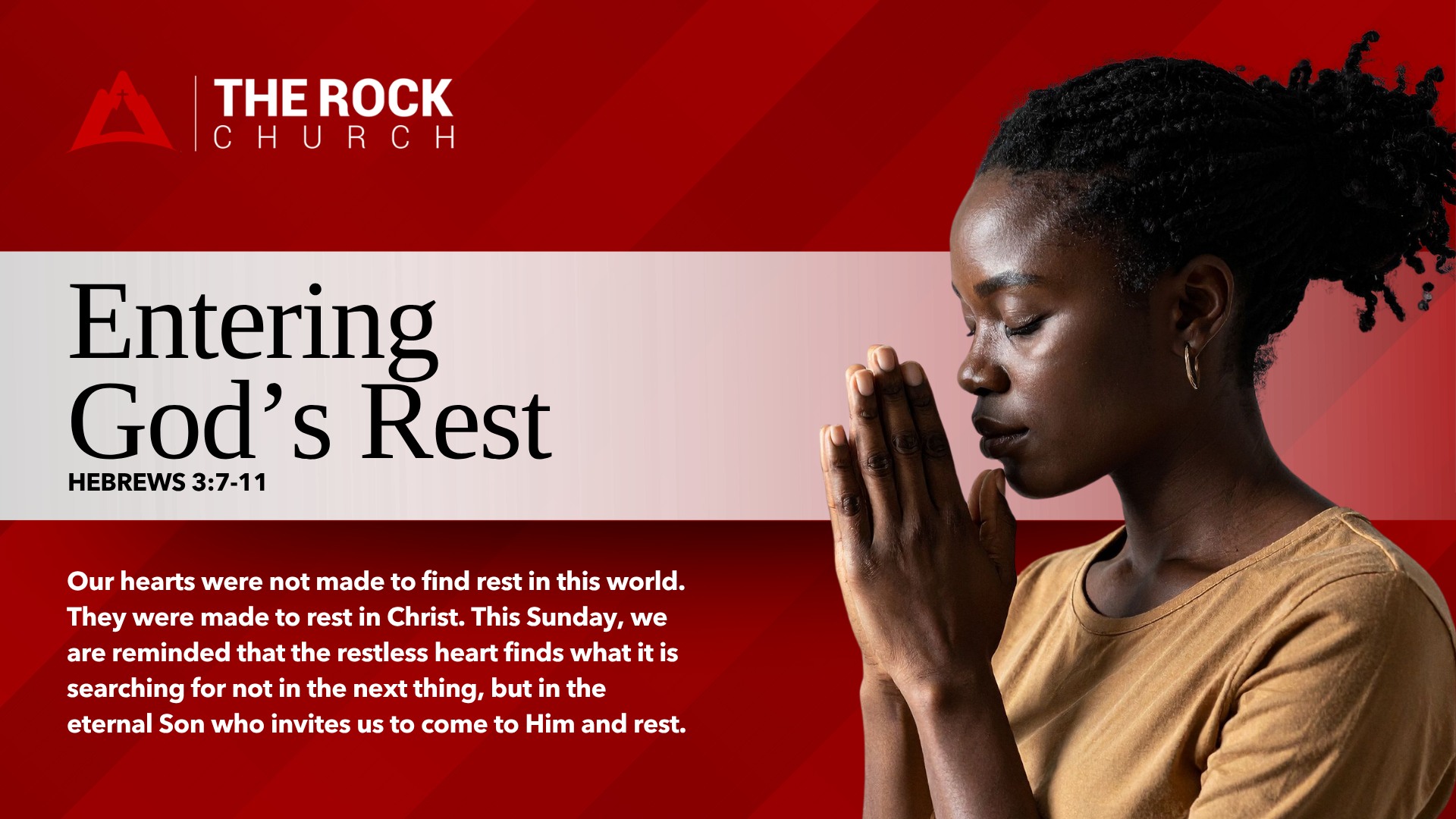
The following is a sermon transcript from our Sunday Service at The Rock Church in Mount Laurel, New Jersey. Each week, we gather to worship, learn from God’s Word, and grow together. This transcript is provided as a free resource to encourage and equip you in your walk with Christ. While you’re welcome to read and share this content for personal use, we kindly ask that it not be redistributed or published elsewhere without prior written consent from The Rock Church.
Introduction
“You have made us for yourself. And our hearts are restless until they rest in you.” These are the words of the famous Saint Augustine just a decade after his conversion in the fourth century.
Here was a man who sought rest in created things rather than the Creator. Worldly pleasure, success, status and career advancement, philosophy and false religion — all the things that the world promises will bring rest to the soul but never do. Always searching but never arriving at truth, peace, and rest.
It was his mother, Monica, who prayed for him for years as he wandered farther and farther away from the Lord. And then finally, under the preaching of Ambrose in Milan, the Lord began to change his heart.
Augustine recalls the moment. It was in the garden. Under this deep sense of conviction, he heard a voice: take up and read. And what did he turn to? But the pages of Scripture — Romans 13, verses 13 to 14 — which calls believers to put off sinful living and put on the Lord Jesus. He referred to it as a light of confidence that was flooding his heart. His soul that was wandering had finally come home to rest.
And so the question before us this morning is not simply Augustine’s story, but it’s our own. The question is: how is your rest in Christ?
That’s the focus of Hebrews 3, verses 7–11. As we consider together what it means to enter God’s rest. Because what Augustine discovered in the garden is the very same thing that Hebrews is calling us to today.
The restless heart finds rest — not in this world, but in Christ. Not in the pursuit of self, but in salvation. Not in control, but in surrender. Not in temporary comforts, but in the eternal Son.
We are living in an epidemic of restlessness. Distracted minds, anxious hearts, exhausted souls — always searching for the next thing to bring us peace. But what if our restlessness is not ultimately an issue of busyness, but disordered worship?
It’s exactly why Hebrews speaks to us so powerfully. It was written to weary, restless believers who are tempted to do what? Drift away from the centrality of Christ. Hebrews does not say: try harder, be better, find yourself. It says: look to Christ. Hold fast to Christ, enter into His rest.
Biblical rest is not simply slowing down physically — but a soul that rests in the sufficiency of Christ. You can be physically busy, yet spiritually rested. Or physically comfortable, but spiritually tormented.
Jesus Himself gives us the invitation. He says, “Come to me, all who are weary and heavy laden, and I will give you” — what? — “rest.” It’s not a comfort here or pleasure there, but rest. Rest. And that’s the promise that’s really held out to us in Hebrews 3.
As we consider together: a trusting heart hears, follows, and rests. We’re going to look at three postures of the heart from the text:
First, a believing heart trusts the Lord instead of testing Him. Secondly, a wandering heart resists God’s ways and drifts towards sin. And lastly, a resting heart longs for the eternal rest to come.
Point One: A Believing Heart Trusts the Lord Instead of Testing Him
And so the writer of Hebrews begins with an urgent call from Psalm 95. As we read together, verses 7 to 9:
“Therefore, as the Holy Spirit says, ‘Today, if you hear His voice, do not harden your hearts as in the rebellion, on the day of testing in the wilderness, where your fathers put me to the test and saw my works for 40 years.'”
The Urgency of Today
The Spirit is speaking today. And He says today — not tomorrow, not eventually, not when I feel like it — but now. There is urgency. There is immediacy.
Don’t miss this, dear Christians. Notice the author does not say “the psalmist.” He says “the Holy Spirit.” Why? So that we would clearly understand and be reminded that the author of Scripture is God Himself. He has spoken.
Now, you might be asking: what is He saying? How does God speak to us today? God speaks most clearly through His word. You want to hear His voice? You open the Scriptures. You want to hear His voice? You sit under the preaching of the gospel where Christ says, “Come to me, return to me.” And by His Spirit, God presses His truth upon our hearts. How does He do it? Through conviction, through exhortation, through the ordinary means of grace.
And we have to understand this conditional statement. The Spirit says to hear is to obey. Not to save you. Genuine hearing receives and submits.
Now the world is speaking today as well. And what are you hearing? Find yourself. Discover yourself. Man, do what makes you feel happy. Follow your heart. Work a little harder and you will find all the rest that you deserve. But those are not the gracious words of Christ. He is teaching you something completely different.
And so you have a choice. Are you going to obey the world and all its deceptions, or the voice of the Savior and all of His grace? The time is now. Don’t delay your obedience. Don’t presume upon the grace of God — today means today.
The Danger of a Hardened Heart
There’s a real danger — it’s the danger of a hardened heart. It’s a conscience that is seared by sin. A hard heart can sit under preaching week after week and be completely unmoved. Christian, listen. Pay attention. Don’t miss this. Don’t unknowingly set yourself up against the truth.
Apostasy doesn’t happen overnight. But clearly Hebrews warns about those who ultimately reveal that they truly never belonged to Christ, savingly. But we have to watch — as the theme of Hebrews — this strong exhortation: watch for the subtle drift, a quiet turning from the living God.
“Oh, Pastor, I’d never do that. It wouldn’t happen to me.” But our hearts — they’re prone to wander. And if we’re not continually fixing our eyes, our gaze upon Christ, that drift — you know — it happens slowly, quietly.
The Sin of Grumbling and Unbelief
The author now reaches back into one of the darkest moments of Israel’s history. The Spirit’s call becomes very personal when we realize Israel’s problem was not outward slavery anymore. It was inward unbelief.
Imagine being delivered from slavery and bondage. You saw the Lord’s outstretched hand parting the sea, leading you into safety. But what do you do? Rebel against the very God who saved you? Is this rebellion and open rejection of God? No. It’s the ongoing murmuring, the complaining. At its root, sinful grumbling is always against God. It says: God, you’re not going to do in my life what I think you should do. God, I have worked so hard. I’ve been through so much. And now I’m wandering in the wilderness — wondering if you really care for me? Slowly drifting into unbelief.
Unbelief is a stubborn heart. It says: God, I know you did amazing things for me before, but I don’t think you really want to do anything for me now.
Why is it that even as children of God, we doubt the goodness of God? Why does that creep into our lives as believers?
Exodus 17, verses 1 to 7. The people of God are quarreling with Moses. There’s no water to drink. “God, you have left us to die in the wilderness.” Moses is beyond frustrated. “What shall I do with this people?” he says. It’s overwhelming. And what are these people doing? They’re testing the Lord.
What It Means to Test the Lord
What does it mean to test the Lord? It’s this unbelieving suspicion. God, you must prove yourself again. God, your past faithfulness isn’t really doing it for me. God, I will trust you only if you meet my demands.
A believing heart says: I don’t understand, but I will trust you. A testing heart says: I will only trust you if you satisfy my conditions.
Children love to ask their parents, “Why, Daddy? I don’t understand.” And every parent says in response, “Trust me. I know what’s best for you. Don’t you know that I love you?” But for whatever reason, we do the same thing with God. And it comes in a twofold way: Is God able? Is God willing?
First, we forget all about the all-powerful God who loves His dear children with a love that is greater than all of our sin. We turn to any other means instead of the One who is the source of all power and all ability. Secondly, we doubt if God is really willing. Does God really love me that much that He will provide for all of my needs? Or should I take matters into my own hands?
Are you hearing God’s voice? I don’t think so — on those questions. I think there are some competing voices that are trying to get your attention. Don’t do it. Don’t fall for it. Obey the voice of the Lord today.
When the Israelites continually tested the Lord, the Scripture says they provoked His patience. It was 40 years that they wandered in the wilderness and forgot all about God’s powerful deliverance.
Now remember, God does not reluctantly tolerate His elect until He finally snaps. It’s not what we’re talking about here — God’s patience running out and then He explodes. No, no. But you may be wandering right now in the wilderness of sin, thinking somehow it will satisfy. Things will get better. I just need to wait it out. No, no, no. Don’t do that. Turn from your sin. Turn from the hardened heart. Repent and believe. Trust the Lord. Don’t test Him.
The Christian life is about repentance. It’s that reminder when you get angry with your kids. When you start thinking, you know, life would be a lot easier if I just went the way of the world. May what happened to the Israelites not happen to us. It’s a call — check your heart.
Christian, God has settled the question once and for all — whether He’s able and willing to care for His people. Romans 8:32: “He who did not spare His own Son, but gave Him up for us all — how will He not also with Him graciously give us all things?” This is why we must take unbelief seriously. Because hearts don’t drift toward Christ naturally. It’s just not what we do.
Point Two: A Wandering Heart Resists God’s Ways and Drifts Towards Sin
Left unchecked, the heart begins to wander. And now the author here exposes what a wandering heart looks like. Look at verse 10:
“Therefore I was provoked with that generation, and said, ‘They always go astray in their heart. They have not known my ways.'”
The Heart Is the Real Battlefield
The Lord is now exposing the deeper issue beneath Israel’s wandering. Their greatest problem was not the wilderness around them. It was the wandering within them. They always — always — go astray in their hearts. The outward rebellion was the overflow of the inward wandering.
Now this does not give us permission to become self-righteous toward others. “Look at you, always wandering inwardly. Look at those Israelites — so foolish.” The point is not superiority. The point is self-examination. Understand this: the issue is the heart. This was not occasional wandering. This was a pattern of their hearts.
John Owen famously said, “Be killing sin — alone. Or sin will be killing you.”
Isaiah 53:6 says, “All we like sheep have gone astray. We have turned everyone to his own way, and the Lord laid on Him the iniquity of us all.” We like sheep are prone to drift away, become lost, need a shepherd. But here’s the good news — the Lord laid upon our Savior all of our sin.
The Problem of Forgetting the Gospel
The problem is that we’re always forgetting what Christ has done for us. We forget the gospel, we forget our inheritance, and slowly our hearts become enticed by the world, the desires of the flesh, and the lies of Satan.
Spiritual drift does not happen in an instant. Healthy marriages don’t fall apart overnight. It starts with small neglects, fewer conversations, less affection, unresolved frustrations. Drift happens slowly. And spiritually, the same thing happens when we stop trusting God’s ways. We stop trusting that His ways are truly better than our ways.
The Lord says, “Here is the way, walk in it.” But our hearts respond, “Lord, I think my way will satisfy more.” And we pursue sin, believing it will give us the rest that only Christ provides.
Titus 3:3 — “For we ourselves were once foolish, disobedient, led astray, slaves to various passions and pleasures, passing our days in malice and envy, hated by others and hating one another.” You see that word? There it is — led astray. It was who we once were. Foolish, disobedient. Why? Because our passions and our pleasures ruled over us. All we could think about was: man, I’m so angry about my life. I deserve everything that my neighbor does.
The Gift of the Church
But here is God’s kindness toward us — wandering people. God has given us this wonderful thing called the church, so that when we see a brother or sister wandering, we can say, “Hey man, come on back to the truth.” And guess what happens? Well, James says that their soul is saved from death.
It’s a warning — not that you can lose your salvation. But someone who walks in perpetual darkness, unrepentance — that’s grave danger. One of the most loving things that we can do as Christians is help each other come back to the truth. It’s not done in self-righteousness or superiority, but with tears, with prayers, with patience.
You see, God uses means to keep His people persevering. He doesn’t just save us and then say, “Man, just figure it out all on your own.” God has given us the church as a means of preserving His people. He uses brothers and sisters right in this room. He uses leaders, elders to lovingly watch over souls, under the authority of Christ, the Good Shepherd.
And understand this — the heart in Scripture refers to the inner person. It’s our desires, our will, our affections. That’s why God is always after the heart first. When the heart wanders, everything else will follow: our attitudes, our desires, our choices. A tender heart grieves over sin. A hard heart excuses it.
Resisting God’s Ways
So what else does a wandering heart do? It resists God’s ways. The author shows that clearly: “They have not known my ways.” At the root of sin is a refusal to truly know and trust God.
Now what does it mean to not know the ways of the Lord? It’s not trusting. It’s not believing that God’s ways are truly better for us. We resort to this — it happens to us. We go to that same old thinking that Adam and Eve did — as they were deceived by the ancient serpent, the devil. Instead of knowing God as good and gracious and kind, they thought of Him as: man, He’s kind of wicked, a bit of a taskmaster, trying to steal our joy. I want that tree. Instead of finding rest God’s way, we choose our own way.
Christianity is not mere rule-keeping. It’s knowing God’s character, His nature, His will for our lives. It’s His loving kindness that leads us to repentance. It’s realizing the extent of His great love for us in the person and work of Christ. And it’s humble submission — it says, “Yes, God. I know. I know your ways are better than mine. I’m tired. I’m tired of doing it my own way. It only leads to disappointment, discouragement, failure.”
Sometimes God allows us to feel the emptiness of our own ways so we can realize how much we need Him. Think about the Prodigal Son. He took all of his father’s inheritance and he went nuts — drinking and partying and carrying on, spending everything. And finally, he hits rock bottom and he realized one thing: I need to go back to my father. I don’t know if he’ll receive me, but I’m going back. What is that? That’s repentance. That’s what we need to do every day.
But because the Israelites drifted towards sin, resisted God’s ways, He was grieved. Now we know that God is not looking down from heaven, watching for our next mistake and failure, so that He can bring crushing punishment on us. Now remember this — the Lord laid upon Christ all of our sin. All of the wrath of God was satisfied upon the Son. But we can certainly grieve the Lord. Ephesians 4:30 tells us: “Do not grieve the Holy Spirit of God.” Why? Because He’s the one that sealed you until the day of redemption.
Listen — we need to know what God has done for us before we know what we can do for Him. Telling a believer not to sin is one thing: “Hey man, just quit it. Stop. What’s wrong with you?” But to remind them of what is guaranteed for them — that changes something. That’s a gospel motivator. The Spirit of God dwelling in me, sealed until the day of redemption.
Imagine how unloving it would be for God never to discipline us. He sees our drifting towards sin. He sees that we’re resisting His ways, but He does nothing. He’s up there, busy on other things. That’s not a good father. Thankfully, we have a good Father who lovingly corrects us.
This has probably happened to you. You’re walking around a store and there’s this wild child running down the aisles — every game, every toy, every paper product thrown into the aisle. And right next to him are his parents. They do nothing. They say nothing. And you start wondering: why is no one correcting the child? But not so with our God. He’s better than the best parents. He is faithful to bring us back from our wandering, show us how much better it is to walk in His ways and His truth. That’s the heart of verse 10.
Every wandering heart — every one of them — is ultimately searching for rest. Don’t forget what Augustine said: “You have made us for yourself, God. And our heart is restless until it finds rest in you.”
You see, that’s the tragedy of sin. I do it. You do it. We keep looking for rest in places that never give it. But remember — verse 11 reminds us that true rest is not found in this fallen world. It’s found in the Lord Himself.
Point Three: A Resting Heart Longs for the Eternal Rest to Come
It’s verse 11:
“As I swore in my wrath, ‘They shall not enter my rest.'”
The Weight of God’s Oath
God’s declaration — the Israelites’ punishment. Listen: God does not swear as we do. He is in the heavens and He does what He pleases. His oath, His promise — it’s settled and determined.
The Israelites also had a determination in their hearts. They refused to repent. They refused to return to the Lord. And sadly, it had consequences.
Our sins have been forgiven in Christ. But they also have real consequences in this life. Unrepentance — willingly, ongoing — invites God’s heavy hand of correction. What could have been a gentle hand, what could have been a quiet correction, instead invites something heavier.
As our confession reminds us, believers may incur God’s displeasure and grieve His Holy Spirit, even though they are never finally cast off by Christ.
A husband may truly belong to Christ, fully forgiven by the Father — but if he refuses to repent of his anger, harsh words, neglect of his wife, those consequences are real. Trust weakens. The marriage suffers. The kids feel the tension in the home. What used to be a place of peace and safety is no longer. The guilt of his sin is gone, but the damage of his unrepentance is real. His life and relationships are marred until he brings his sin to the light, until he repents and finds that restoration.
It was 40 years that the Israelites wandered in their hearts. And God’s judgment was not some impulsive anger. No. But it was His holy, righteous opposition to persistent unbelief. Because God stands opposed to man’s disobedience and persistent unbelief.
Understand this: there’s a difference between God’s fatherly displeasure toward His children and His judicial wrath toward the reprobate. Spurgeon warned that sin gradually petrifies the heart. You know, petrified wood gets harder, turns to stone — not a good thing.
But don’t misunderstand God’s righteous anger. Moses reminds us of that in Numbers 14:18 — “The Lord is slow to anger. He’s abounding in steadfast love, forgiving iniquity and transgression.”
The Real Consequence: Removal of the Promise
The real consequence for the Israelites was the removal of the promise: “They shall not enter my rest.” They shall not enter the Promised Land of Canaan.
Imagine that. Standing on the edge of the Promised Land. You can see it. It’s right there. And then you’re being told: sorry, you wandered. You remained in unbelief. You refused to repent. You’re losing the promise. How crushing. How devastating for that wilderness generation. They heard the promise their whole lives. But because of their unbelief, they never entered it.
He gives the promise to Caleb and his generation. And sadly, even after the next generation enters the Promised Land, they still find no rest. Why? Because God’s promise of rest is not in a piece of land. It’s not in any other physical thing.
The Eternal Sabbath Rest
Why? It’s the final resting place. It’s the place of perfect blessedness. Imagine for a moment what it would be like. No more anxiety. No more depression. No more sleepless nights. No more temptations. No more indwelling corruption. We will finally love God again — with all of our hearts and our minds and our strength. In totality. The perfect is yet to come.
And a resting heart does not long for rest in this world. It’s like the faithful, diligent employee. He works his whole life so he can hear those words — “Congratulations, you’re retired.” It was the promised rest that he’d been waiting for his whole life. I put my time in. I did my duty. I provided. I worked hard. And now — there’s rest.
We don’t have to be retired to know this. We work all year long, with the joy of finally two weeks of touching those feet down into that nice warm sand. “Oh, I can’t wait for that.” That day is coming. But it’s Disney World — and you’re more tired after that trip than when you started. “Lord, put me back in that cubicle. My feet, my body — I can’t take it anymore.”
Listen, I’m not condemning rest. I’m simply exposing that false rest does not deliver on its promises. A resting heart longs for eternal rest to come. This is the promised place. This is the resting place.
The Israelites missed it. It’s not in a land. It’s the promised place for all persevering believers — after all the toils and trials of this life finally come to an end.
The confession says: God preserves His saints. Listen. God preserves His saints so that they shall certainly — certainly — persevere therein to the end and be eternally saved.
We Are Travelers, Not Settlers
Remember — in a lot of ways, we’re just like the Israelites wandering in the wilderness of this world. But we are travelers. We’re not settlers. I want you to think of your house as more like a tent. Don’t put all your energy and effort into making it look better, making it more beautiful. It’s just a temporary dwelling. Yes, do the maintenance. Don’t let the roof cave in. But don’t treat your home like it’s your forever home. Heaven is your forever home.
Keep enduring. Keep looking to Christ. Yes, we have rest in Christ now, but we have yet to fully experience it. That’s the constant struggle of the already — but the not yet.
Don’t you long for that? Don’t you long for that day? That’s a very healthy thing — to long for heaven. But sadly, many believers feel guilty about thinking too much about heaven. “Doesn’t that mean that I forsake all my earthly duties?” No, no, no. Not at all. It puts everything in this world in the right perspective. Your career and your home are all temporary. Eternity with our Lord is forever. Forever.
Longing for heaven actually strengthens your endurance. It keeps you thinking more about holiness rather than worldly comforts. It keeps all of life anchored in the most important reality: this earth is not my home. Every struggle, every burden is a reminder to keep hoping in the eternal.
It’s divine. That’s eternal. It’s the Lord’s divine, eternal Sabbath rest. And guess what? He showed us that picture in the beginning — Genesis 2:2. That’s where rest is first introduced. And then it’s going to have its final consummation in the new heavens and the new earth.
Conclusion
So as we close, where does that leave us?
We began with the story of Augustine. He was a very skilled wanderer. He attempted to find rest in all the wrong places — pleasure, success, philosophy, false religion. But it wasn’t until he heard God’s voice on the pages of Scripture. And he would later pen those famous words. Hear them again:
“You have made us for yourself. And our heart is restless until it rests in you.”
So I must ask you — where are you seeking rest?
Have you heard the call that a believing heart trusts in the Lord instead of testing Him? Have you heard the warning that a wandering heart resists God’s ways and drifts towards sin? And most importantly, have you heard of the future hope that a resting heart longs for the eternal rest to come?
Dear Christian, a trusting heart hears, follows, and rests. Let’s be faithful hearers of God’s voice in God’s word. Let’s be humble servants who submit to God’s ways, repent of our sin, and let’s be patient pilgrims who look forward to the eternal rest to come.
As we consider these things, let’s go to the Lord. Let’s just confess our sin. And then let’s receive assurance of pardon that all of our sins have been forgiven. He’s not surprised. He’s not caught off guard. Just come to Him and say: “Lord, my heart — I need you to tenderize it. I need you to break it down a little bit. I need you to work in me. I’m not trusting you, Lord. I’m not believing your ways. I’m going my own way. I need your help.” And He meets you there in that place and extends to you much grace.
These warnings are not made to scare you. They’re meant to sober you. Christ gives rest to His people, and our hearts are restless until they rest in Him.
So let’s go to Jesus now.
Closing Prayer
“You, Lord, we’re so thankful that we can have even a moment of quiet to come before you. No sounds, no distractions — just being with you, sitting at your feet and learning from you. God, you are so kind and merciful. May we not consider your righteous indignation as something not befitting to who you are. God, you are holy, you are righteous, and you love us as your dear children because you have placed us in Christ. And Lord, we know our hearts continue to wander to other things — to the things of the world, to the desires of the flesh, and to those deceptive voices from the enemy. But may we hear your voice, Lord. May we harden not our hearts as the Israelites did, as they tested you, as they tried you in the wilderness for 40 years. May we simply walk by faith, trusting in your promises. And going forward from this place in the power of your Spirit, knowing that you are for us. And nothing can separate us from the love of God that is in Christ Jesus. And we pray this in your great and glorious name. Amen.”
Ready to Take Your Next Steps at The Rock Church in Mount Laurel?
The Rock Church in Mount Laurel, New Jersey exists to help people know God, follow Jesus, and make disciples who multiply. Whether you’re new or already part of our church family, we’re here to help you stay connected! Plan your visit to experience a Sunday with us, or download the Church Center App to stay updated, join a group, register for events, and more.