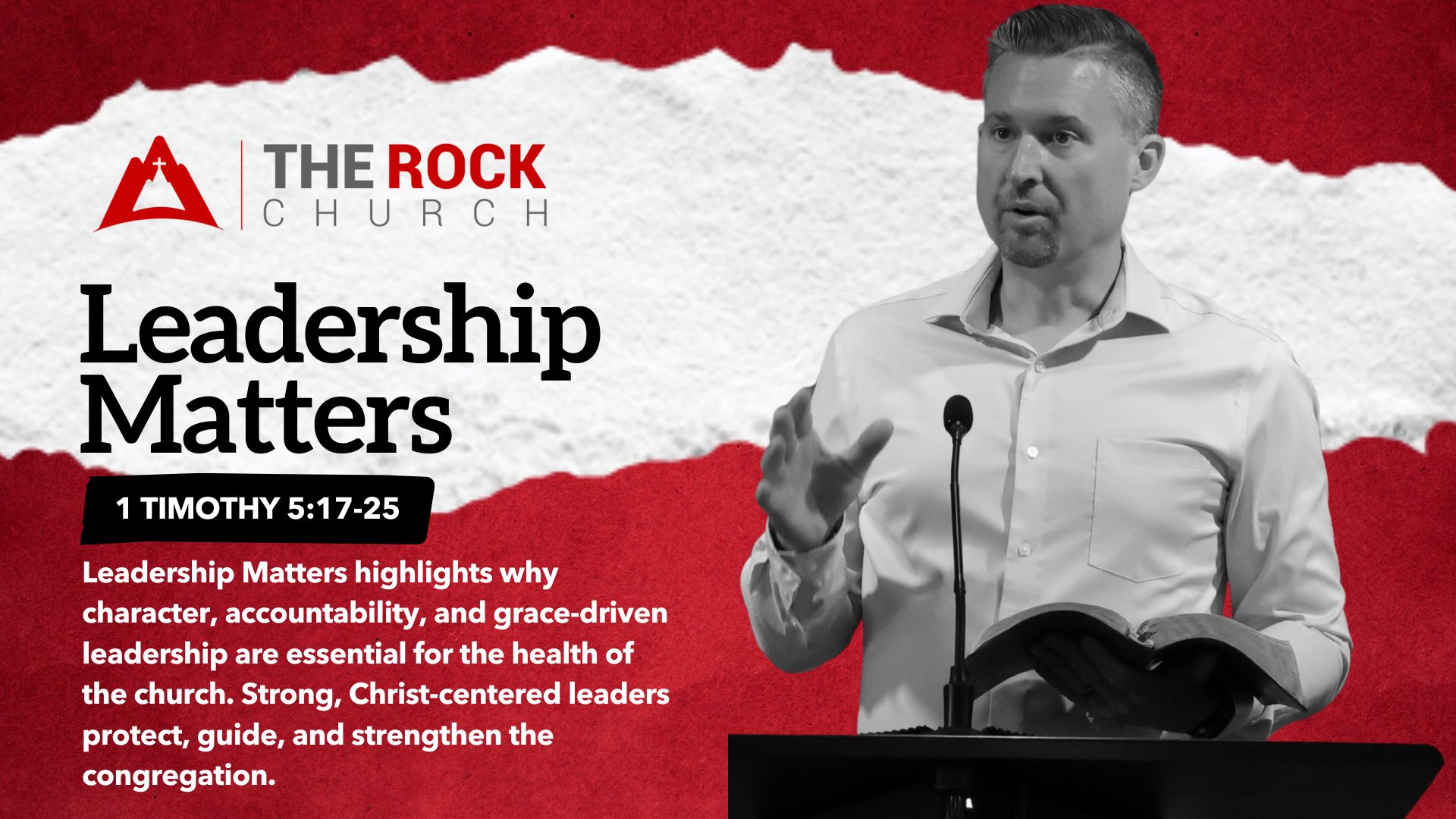
The following is a sermon transcript from our Sunday Service at The Rock Church in Mount Laurel, New Jersey. Each week, we gather to worship, learn from God’s Word, and grow together. This transcript is provided as a free resource to encourage and equip you in your walk with Christ. While you’re welcome to read and share this content for personal use, we kindly ask that it not be redistributed or published elsewhere without prior written consent from The Rock Church.
Recently, I read a story about two church planters, both of which loved the Lord Jesus and sought to help others know Christ for the glory of God. However, the one led with an agenda rather than a vision for the kingdom. He worked hard, constantly trying to convince people that he had the best ideas for how the church should operate. Instead of a strong understanding of self-awareness and focus on building others up, it was all about his own personal vision. In time, he only inspired fear and distrust. The volunteers were constantly walking on eggshells and experiencing burnout instead of a culture of joy inspired at burden and despair. In just three years of ministry, this pastor was overwhelmed with discouragement and resigned.
The other pastor was different. He led people toward a vision that included everyone. He was a collaborator, and he wanted everyone to work together toward a common mission. He was quick to admit when he made mistakes, and he invited others to provide feedback. He cared about his team and made it his priority to serve rather than to be served. His church not only survived, but thrived, even in the midst of all the challenges of the pandemic.
And the question that comes to mind is, why did the one church die while the other flourished? I think it’s obvious. Leadership matters more than we give credit for. Churches often think for them to do well, all they need is a gifted preacher and some good music. It’s charisma over character. It’s giftedness over godliness. It’s what has plagued evangelicalism over the years. Celebrity pastors who think that the success of the ministry is based on how well they can communicate and how well and attractive their church model is.
One thing becomes very apparent over time, and that is character. The cracks in the pavement begin to appear, but the elders look the other way, and worse yet, they protect the pastor from any measure of accountability. They begin to wonder why so many people are leaving the church. Well, it must be something wrong with them, they say, because we’re doing everything right. We care about God’s word. We care about doctrine. Those people are deceived.
Before you know it, the leaders of the church are demanding respect and lording over the people instead of earning honor and serving in humility. The church wants to grow, so they lower the standards of leadership because they need to fill the positions. They begin to cater to special interest groups within factions of the church, and they impose law over grace. They allow leaders to walk in hidden sin before eventually it all comes out and the people are not only hurt, but traumatized. This is not God’s vision for leadership within the church.
If we truly believe that proper care for Christ’s church is of the utmost importance, then we will keep the standards for leadership high and the tolerance for sin low. This morning, I want to talk about why leadership matters. So if you’re taking note, as we often say, write down the big idea. It’s this:
The church that elevates the standards of leadership not only protects its members, but also strengthens the entire congregation.
And I have five points, as a good Calvinist would:
- Leaders who lead effectively must be honored and respected.
- Leaders must be held accountable at the highest level without compromise.
- Leaders who embody objectivity and wisdom inspire trust and they drive meaningful progress.
- Leaders who understand grace, they properly encourage others to appropriately exercise their Christian liberty.
- What is hidden will eventually be revealed. So live openly and authentically.
1) Leaders who lead effectively should be honored and respected (1 Tim 5:17–19)
Let’s look at the first point. Leaders who lead effectively should be honored and respected. That’s what Paul tells us. Verse 17 to 19: Let the elders who rule well be considered worthy of double honor, especially those who labor in preaching and teaching. For the scripture says, you shall not muzzle an ox when it treads out the grain. And the laborer deserves his wages. Do not admit a charge against an elder except on the evidence of two or three witnesses.
Now as we consider leaders in the world today, many think to themselves, man, why is it so hard to find them? Why is there scandal after scandal, character flaw after character flaw? Surely it wasn’t always this way. There must have been a time when leadership really mattered greatly and people really took it seriously. They knew why they were serving. They didn’t have a personal agenda. So what’s happened in our culture? Is this a new thing? Or is there really nothing new under the sun? Quite frankly, I would argue the latter is true. Leadership has always been an issue, whether a country or a corporation. And the ones that apply principles of sound leadership always do better. Yeah. The health of the country or the corporation or the church is at stake.
However, the church in America seems to have borrowed from the world’s way of thinking. To grow a church, we need the right programs and the most talented people. But what are we seeing here from the Apostle Paul? What does it mean when he refers to elders who rule well? Is it those who are the most capable, most intelligent and most gifted? Well, no, that’s only part of the equation. A better way to translate this phrase is elders who preside over the church. They’re not ruling with orders and dictates and rules and fear. Instead, they should be leading with honesty and uprightness. They set the example for others to follow. They exercise not only wisdom and ability, but also loving faithfulness. They’re not in it for their own glory. It’s not about power, platform, prestige.
And this standard of leadership is not a new concept to the New Testament. It goes back to Exodus 18, verses 21 to 23. To set the scene, it’s Moses leading the people of God, now finding himself in a very difficult situation. Why? Because he’s making all the decisions about every dispute among the people. And here comes his father-in-law, Jethro, who says, hey man, this ain’t good. You’re going to burn yourself out. Here’s what you need to do. It’s verse 21. He says, look for able men from all people, men who fear God, who are trustworthy, and they hate a bribe. Isn’t it true that the same principles apply today? A leader is only as good as the people he’s able to raise up and serve in the mission of the church. What do you think would have happened if Moses said, you know what? I need leaders, and I’m just going to pick the most talented. Itdoesn’t matter if they have a few character flaws here or there. As long as they can do the job, I’ll be just fine. Well, of course, it would have been a disaster. The people would quickly remember the proverb that says, when the righteous rule, the people rejoice. But when the wicked, they groan. It’s the groaning that happens at the water cooler of any company as the leaders don’t care about their employees. It’s the students who have the teacher who’s only there for the paycheck.
But how should we respond to a leader who does well, and particularly an elder in the church? Well, we should fight against the urge to put him in the same camp as the rest of the world. As one commentator put it, the elders who rule well should receive both respect and remuneration. They should receive both the honor and the honorarium. Yeah, this is an issue of respect for the elder, but it’s also paying him fairly and generously.
And Paul goes a little further when he talks about those elders who have the task of preaching and teaching. Why is that so especially important? In fact, Pastor, I see where you’re going here. You’re the elder who preaches and teaches. So you’re going to make that shameless plug for next year. Worse yet, you’re going to ask for a 50% raise because it says right here, every elder is worth double honor. No, of course not. The principle is simple. If the leader leads well, he should be treated well.
There are certainly some churches that don’t have this approach. They treat the elder pastor as a hireling who serves at the pleasure of the people and must do everything they tell them. So he should be paid just enough to get by. Now, thankfully, our church is a generous one. While I don’t know how much anyone gives, I do know this: you are a generous people. And I already feel that double honor to serve you because I never worry about my needs getting met. Praise God for his faithfulness as expressed through you.
Notice again the importance of both preaching and teaching. As I’ve said before, if all I do is preach, you will walk away feeling encouraged but something missing. If all I do is teach, your heart will be lacking while your mind will be enriched. This is the difficult task of both preaching and teaching. It’s by far the most important part of my job because without it, our church is left with little depth and lacking in the Holy Spirit’s power.
Paul even quotes here from Deuteronomy 25, verses 4 and 15. It seems silly to talk about an ox treading out the grain. What does that have to do with an elder? But the idea is this: if God cares so much about feeding an animal who’s doing the work for the farmer, how much more does he care about those who labor in preaching and teaching in the gospel? It’s true. No good farmer would starve the very animals that make his living possible. And no good God would keep his elders who labor with honor without pay.
How long would you work at a job that began reducing your pay? Sorry, the company is short on cash. We promise to pay you next time. But now you’re working for free and your family’s going hungry, but you keep working because you think it’s the honorable thing to do. Of course, you would never do that. You have an agreement with your employer that your work is worth a wage. As long as you produce for your boss, he must pay you.
So while good leaders are hard to come by these days, we should still honor those that meet the standards. Why? Because it makes leading that much more rewarding and fulfilling. It helps the leader from feeling like he’s never good enough, will never rise to the acceptable level of the standard. In fact, Romans 13, 7 says, pay to all what is owed them:
taxes to whom taxes are owed,
revenue to whom revenue is owed,
respect to whom respect is owed,
honor to whom honor is owed.
So that’s the first point. Leaders who lead effectively must be honored and respected.
2) Leaders must be held accountable at the highest level without compromise (1 Tim 5:19–20)
Secondly, leaders must be held accountable at the highest level without compromises. Verses 19 to 20, we read together:
Do not admit a charge against an elder except on the evidence of two or three witnesses. As for those who persist in sin, rebuke them in the presence of all so that the rest may stand in fear.
Why is accountability so important in the life of an effective leader? Well, sadly, many of you have experienced leadership failures, which caused you to leave the organization or the church. What’s the common theme? Well, he just never admitted to being wrong. Or worse yet, he could never be challenged in anything he did.
It comes back to the important discussion around plurality of elders. What does that mean? Yeah, if you see any reference to elders in the New Testament, guess what? It’s always in the plural. There’s never a reference to just the elder or the man of God. The head elder. No, it’s a true plurality of elders means that all the elders are held in equal authority. Yes, the lead pastor is the lead of the elders, but that doesn’t mean that he is exempt from the highest level of accountability. Because without accountability, the only voice the lead pastor has to listen to is his own. And that is a very dangerous thing indeed.
In fact, some senior pastors think they hold the role that is simply that of Moses. But even Moses listened to his father-in-law Jethro and took his advice. Imagine that. Here’s a man who’s quite literally the prophet of God who hears special revelation from the Holy Spirit to then in turn dispense to the people. But he even had the humility to know that there’s only so much one man can do.
The Bible says that a man who isolates himself seeks his own desires. It’s Proverbs 18:1 which says, whoever isolates himself seeks his own desire. He breaks out against all sound judgment.
Has that ever happened to you? You go to a leader with a concern and it seems like he has departed from all sound wisdom. You are just aghast at the insanity that you are witnessing before you. Whoever isolates himself seeks his own desires and breaks out against all sound judgment.
Why did he do that? Because he’s isolated himself both from God and man. And thankfully God never operates in a vacuum. He will confirm a matter with more than one person. And this is why one single accusation against an elder should not be accepted.
Now of course if someone raises a concern with an elder, it should always be listened to. Paul was trying to get to the point that there was a special attack going on. But if the matter is significant enough, there better be some witnesses to confirm that it’s true.
Why? Well as you know the elders are on the front lines of spiritual battle. So when the attacks come, especially as the truth is maintained, why does this happen? Because some people don’t like hearing the truth. They’re what the Bible says, the chaff among the wheat or the goats among the sheep. They don’t want to hear the voice of the good shepherd. Instead they want their ears to be tickled. They want to feel good in their sin.
So when an elder advises a congregant that sin is sin and God takes it seriously, they get mad. As I mentioned before, we had a lesbian couple that came to our church fora short time. And we loved to have them. It was fine. But as elders, Duncan and I and Ralph explained to them, we love that they’re coming, but we want you to know where we stand on homosexuality. We believe it’s a sin. You’re still welcome to come. Now, one received it. The other one didn’t like it. They left the church, sadly didn’t come back. But the simple matter is that elders are easier targets for false accusations than those who are simply the church attenders. We’re all open to it, but there’s a special attack that can come to the elders.
And this principle of two or three witnesses goes all the way back to Deuteronomy 17 and verse 6. It was part of the judicial practice for the people of God when rendering punishment. Now, to be clear, in this context, Paul’s not saying to apply the judicial practice here to the elders.
Instead, this is existing here in the text to admonish the elders who think they can get away with anything because of their position. And while it shouldn’t be easy to come up with any old accusation against an elder, this issue of persistent sin applies both to the leader and to the laity. Notice, in other words, perpetual sin in the life of any believer should be a grave concern.
Now, I’m not saying that any of us here don’t have ongoing sin in our lives. That would be a ridiculous statement. In fact, it doesn’t take me very long to take my eyes off of Christ and put them on myself. And that’s by definition sin. Only a few minutes into waking up does that happen. I like, though, how one commentator put it: Private sin needs to be dealt with privately, whereas public sin needs to be dealt with publicly. What does he mean by that? Well, I think you might be able to guess. We all have sin in our lives. It’s normal, but it’s not okay. And the struggles we face with sin remind us that the power is not in ourselves to be better, but in Christ who is alive in us. It’s a reminder of how weak we are. In fact, the Apostle Paul considered himself to be the chief among all sinners. It seems like false humility, but the more we grow in the Lord, the more that we mature, the more that we see our sin and our need of Christ. The more we grow in childlike dependence on the Lord. Not independence, dependence.
The more we must hear the preaching of the gospel, especially when someone offends us or we hurt ourselves. It comes back to this process that Jesus talked about himself in Matthew 18, verses 15 to 17. This idea of church discipline involving members of the church:
Someone sins against you. Go to them. Tell them their fault.
And if they listen, that’s great.
But if they don’t, bring someone else.
And they still don’t listen, bring them before the church.
If they still don’t listen, then excommunicate them from the church.
But inherent in the process is not punishment and embarrassment. That’s not the point. The goal is repentance and restoration. This is the heart of our dear Savior. That we would all be one as he is one with the Father. Unity is a very important thing to protect in the life of the church.
But public sin is a whole different matter. It’s that sin that’s plain and obvious to everyone in the church. For example, someone is caught in adultery or another who’s living with someone who’s not their spouse. That’s what Paul’s talking about here. Someone who’s in persistent, open, public sin. Comes into the fellowship. Others look on and say, man, if that’s okay with them, boy, I guess I’d be okay if I continue in some open sin. It’s willful rebellion against God that not only hurts the sinner, but it hurts others. And the church that tolerates sin in this way will be hurt as a whole. It’s like a cancer that spreads. How’s that? Well, one person engages in public sin without any consequence. And it will beclear to another, I guess that’s okay. And before you know it, there’s open sin among all, leaving the church to look exactly like the world. Instead of the salt to preserve the flavor, it’s the rotting that corrupts the whole fruit. Instead of being light of the world, it’s darkness and depravity. This is why public sin needs to be dealt with publicly, as Paul described it, according to a process.
If we brought a leader of our church before you and let him know what sin he was involved in, it would affect you deeply. And what’s that effect? It’s sitting in fear thinking, oh no, I don’t want that to happen to me. But again, this is the last step in the process of Matthew 18. When all else fails, bring them before the church and rebuke them publicly and then send them out into the world. This is why leaders need to be held accountable at the highest level without compromise. As soon as compromise is introduced, everyone suffers.
3) Leaders who embody objectivity and wisdom inspire trust & drive progress (1 Tim 5:21–22)
Third, leaders who embody objectivity and wisdom inspire trust. They drive meaningful progress. It’s verses 21 to 22. In the presence of God and of Christ Jesus and of the elect angels, I charge you to keep these rules without prejudicing, pre-judging, sorry, doing nothing from partiality. Do not be hasty in the laying on of hands, nor take part in the sins of others. Keep yourself pure.
Why do you think Paul uses such strong language here in verse 21? He could have said, hey man, pay attention. Pay attention to what I’m saying. It’s important. He says this important phrase, in the presence of. Isn’t it true that we act a little differently when we are in the presence of others versus when we’re all alone? You’ve heard it said that integrity is who you are when no one is around. But what if leaders always led as if they were in the presence of a holy God? Well, of course, everything would change.
And it’s an interesting thing that when we sin, we often think, oh, no one’s around. Not even God knows what I’m doing. But the reality is that all of our lives are laid bare before the Lord. There’s nothing hidden that won’t be revealed. In verse 21, there are two very important words that Paul gives us, prejudice and partiality. And the question we have to ask is why? Why does Paul feel the need to charge young Timothy to apply these principles without prejudice or partiality?
While it might be obvious, it’s worth going into detail because a leader who’s unable to exercise objectivity will find himself in a lot of trouble. And what do I mean by that when I say that? Consider that every decision made by a leader is done so with subjectivity. Instead of considering the truth, he’s always concerned about people’s feelings. Or worse yet, he makes decisions without considering all the facts of the matter.
And while it’s true that leaders have to make decisions, while at times they only have 95% of the information, but to make a decision based on hearsay or conjecture breaks all trust for the leader, inhibits progress for whatever organization. The people look on and think, man, I can’t believe how biased he is. He’s always favoring certain groups within the church. The leader must know and understand that a big part of leadership is making decisions for what is best for the whole.
It’s a wonderful thing that the church is full of a diversity of people. That’s right, I used that word, a diversity of people with certain desires to do church in a way that they like. And they might say, oh, man, the music, it has to be modern and relevant. Pastor, if you don’t have a full band by next Sunday, I am leaving your church and looking for another. To which I would respond, that’s okay. We just cannot be a church that caters to every preference of every person.
Leaders who lead as people pleasers alone create a church that by nature will not be able to please God alone. And that’s why it’s so important that we continueto emphasize the authority of God’s word. Yes, there are differing methods of how we live this out, but there are timeless truths of God’s word that never change. And while no church is perfect, and we need to be somewhat relevant to the culture, we have to make it our aim to please God with our worship. And that means that some people will visit and not stay. That’s okay, because leadership is not about being right. It’s about doing what’s best for the whole, and that which honors Christ the best way we know how.
And that’s why Paul also says in verse 22, it’s so important not to be hasty in the laying on of hands. Now, what does he mean by that? Is he saying, now, my dear elders, don’t be quick to lay hands, in other words, rough them up on any disrespectful or rebellious member? No, no, no, of course not. The phrase laying on of hands is a reference to ordaining leaders in the church. In fact, last week, we laid hands on the deacons. We commissioned them before the church, the elders and I. We recognized that they have been ordained by God. Why do we do that? It’s the last step in the process. For both elders and deacons who are appointed to service, it’s not that I transferred any special anointing from my hands to them, transferable anointing. Instead, it’s a symbolic act that they’ve been set apart for ministry. It’s a solemn act of consecrated service, reminding them this is a call of God on your life before the presence of God and before the people of God.
Now, what if we were hasty? What if we were quick to lay hands on deacons and elders in our church? In other words, what would happen if we lowered the standard just to fulfill a position and did so out of necessity rather than calling? Well, Paul tells us right here. It results in the leaders having to share responsibility for their sins. What’s he mean by that? Well, simply put, it’s that the sins of the unqualified leader become the sins of the qualified leader. How does that work? Consider the damage that is done by unqualified leaders in the church. You may have met some. And now the elders must attempt to correct it. And it becomes this complete unnecessary mess.
Again, what’s the big idea that we’ve been talking about today? The church that elevates the standards of leadership not only protects its members, but also strengthens the entire congregation. So the opposite is a church that lowers the standards of leadership, leaving its members vulnerable and weakening the entire congregation.
4) Leaders who understand grace encourage appropriate Christian liberty (1 Tim 5:23)
So that’s number one: leaders need to lead who lead effectively, honored and respected. They need to be held at the highest level of accountability, no compromise. They got to embody objectivity. Of course, we’re going to be subjective, of course, we’re human, but they’re focusing on objectivity to inspire trust, to drive progress. And fourth, leaders who understand grace properly encourage others to exercise their liberty appropriately.
It’s verse 23. We’re cruising here. I know it’s five points, hang with me. That’s a lot. No longer drink only water, but use a little wine for the sake of your stomach and your frequent ailments. Now at first glance, this verse seems to be out of place. I mean, look at it, it’s in parentheses. What’s going on here? Now, as we can, Paul is going through a lot of law. If you notice what we’re seeing here, this is the standard, this is what must be met. And it’s important. The leaders need to know what is right and good. But again, what’s the danger of always talking about the law? The danger is that we forget where the power for obedience comes from. We forget who the ultimate standard of leadership is, a person. And I think it’s a wonderful thing that Paul takes a brief moment to pause from the law and insert some grace. What do I mean? Well, consider what he’s saying here. Timothy, it appears you might have this tendency to impose the law, not onlyin yourself, but on others. In other words, Timothy might be so concerned, remember young guy, just coming into the ministry, so concerned about living uprightly, he makes a law for himself: I’ll never drink alcohol, not even touch it.
Now to be clear, this text is not saying that Paul is promoting the use of alcohol. Don’t misread that. What is evident are the dangers of legalism. And you might hear that from some lead pastors who tell their pastors on staff, they say to them, you know what guys? You have a law that I’m imposing. You are not allowed to drink alcohol. In fact, if I find out that you have drank any alcohol, you are fired. That’s one extreme.
However, it’s also possible to go to the other extreme. Oh, drinking alcohol is a matter of Christian liberty as long as I don’t get drunk. And what we have to understand is how the balance of grace gives us freedom. It’s how leaders live in light of grace that encourage others to exercise their Christian liberty appropriately.
Now again, what do I mean by that Christian liberty? Well, it refers to the fact that since I’m in Christ, I’m free from the prison of sin. I can now live in freedom. So when it comes to what I eat and drink and what movies I watch, I have to be sensitive not only to my conscience, but the conscience of others as well. But a leader who understands grace knows how to live out his freedom in the right way.
I remember a Christian brother who told me years ago that his pastor told him, you know what, Tony? You remember Tony? Tony brother? You know what, Tony? It’s law for yourself and grace for everybody else. And I thought about that thinking back. That’s some terrible theology. So I need the law. I have to keep the law in my own strength, but I’ll just give grace to everyone else. No way. I need the most grace. And because I’ve received grace, I extend grace to everyone else. It’s grace upon grace.
So just because there’s a high standard for leaders to meet doesn’t mean it isn’t grace. The grace of God that makes it possible. What’s the difference between those two church planters that I mentioned as we opened? The one that failed and the one that didn’t. Grace.
Oh, but the one was obviously had the right heart. It was all about his heart. You know, he’s a special guy. He was really, he had it together. But that other guy didn’t. But what made that possible for the one church planter to be in the right spot in his heart? Grace. It’s not anything inherent in himself. It’s grace for believers. If we knew how much grace that we received, if unbelievers knew how much grace they received. You hear me? Without grace, we would come into this world and be punished immediately. I mean, I’m talking about instant judgment. We don’t understand grace. I don’t understand grace. God is gracious, slow to anger, abounding in love and mercy.
That’s how we honor elders who rule well. Because we are honoring Christ who made it possible. That’s why we hold leaders to the highest possible standards. Because we’re talking about Christ’s church. And one thing is for sure, you better not mess with his bride.
5) What is hidden will be revealed—so live openly and authentically (1 Tim 5:24–25)
Lastly, what is hidden will eventually be revealed. So live openly and authentically.
Verse 24 to 25: The sins of some people are conspicuous. They’re open, going before them to judgment. But the sins of others appear later. So also good works are conspicuous. And even those that are not, cannot remain hidden.
Now what’s interesting here is how Paul presents two opposing ideas: bad works, good works. Obviously, the bad works are those that are sinful by their nature. And the good works that have their substance from faith in Christ.
So why the warning? Well, this is where it’s absolutely essential that we have a period of open examination for any candidate to deacon or elder. Why? Because as Paul says, some sins are hidden but only later revealed. All of us have this tendency not to deal with our own sin because it’s difficult. And when it comes to facing all the areas where we come short, we certainly don’t feel good about it. But the only way we can do it is by understanding the gospel. We understand tha twe are completely known and yet completely loved by God. That means that there are no surprises with God. It’s not like we finally confess our struggles and the Lord says, “Wow! Man, I didn’t know it was so bad. I’m sure glad you told me.” No, in fact, the best thing that can happen is when we can humble ourselves and discard any notion of our own strength. Then, by God’s grace, he begins to build us back up, showing us how wonderful it is to be in his presence, to meditate upon his word, to sing his praises, to be with God’s people, to walk in the light.
Yeah, public sin is serious. And it must be dealt with publicly if necessary. But all of us struggle with private sin in one way or another. And the best way to deal with it is to share it, share that burden with another brother or sister that you trust. They can help you bear that burden. And guess what happens? Paul says that you’re fulfilling the law of Christ. It’s a beautiful thing when we walk together in love, the unity of spirit, the bond of peace.
So my encouragement is not to allow hidden sin in your life. Just don’t do it. It starts out small, and then it begins to grow. How do you think an honest businessman gets indicted for embezzlement? Well, he just saw $20, grabbed it up, and then there was $100, and then there was thousands, and then there’s hundreds of thousands. It’s the same with sin. Let’s keep seeking Christ to keep sin from growing in our lives because there’s one thing for sure about the flesh. Maybe it’s just my flesh. I’ll let you judge. It is never satisfied. It can never have enough. If you have an issue with pornography, it will never be enough. If it’s overeating or laziness or whatever else, the flesh always wants more and more destructive sin.
Let’s continue to be satisfied in the Spirit, live open and authentic lives, especially as leaders within the church. I don’t want to hide anything. You can tell a fake a mile away. It’s someone that walks into church, they’re all polished, plastic, has it all together. I’m thinking, man. And you know, deep down, there’s something more to that, I think. Well, there always is.
Closing & Application
But as we close today, we’ve got to understand how significant leadership is in the life of the church. It matters greatly, and it’s only by the grace of God that anyone could be qualified to lead as an elder or deacon. For me, it’s the greatly humbling thing to realize that God has charged me to watch over your souls? Excuse me? What was that? How do I do that without trusting that Christ will give me the grace to lead well, to be accountable, to stay objective, to lean into grace, to walk in the light?
In application, I’d like you to consider if there’s any hidden sin in your life. It could be small. It could be large. I want you to pray about it and who you can confess it to if necessary. Make sure it’s someone that you trust. Ask them to pray for you and with you.
As we take our one-minute moment now, ask the Lord Jesus to make it clear, whatever it is. It’s not a surprise to him. It’s so important. God wants us to walk in freedom. That’s the whole point. We think God’s just trying to take my joy. Can’t have a little fun. He wants us to be free. That means take off the weight, take off the sin that so easily entangles you. So let’s do that now. We’re going to take our one-minute moment. That’s where we go to Jesus and say, “Lord, what’s that one thing? Let me confess it to you. And then do I need to share this? Does this thing keep encumbering me? Does it keep holding me? Is it so powerful over me? Bring it to the light with another brother or sister.”
Let’s pray, and then I’ll close in prayer. Our gracious God, we are so thankful that there is therefore now no condemnation for those that are in Christ Jesus. As we come to confess our sins, small or great, we know there’s a promise attached to that, that you will cleanse us,that you will wash us, that the blood of Jesus continues to work in our lives. So whatever it is, Lord, as we bring it to you, Lives. So whatever it is, Lord, as we bring it to you, thank you that you’re not surprised. Thank you that you don’t throw it back in our face. Thank you that you don’t hold it over us, but you’ve taken it from us as far as the east is from the west. Your sacrifice on the cross was sufficient to pay for all of our sin, past, present, future.
So help us, Lord, to continue to walk in the light, to humble ourselves, and know that you will build us up. You will strengthen us by your grace. You will raise up leaders. You will protect your church, and the gates of hell shall not prevail against her.
So here we stand, Lord. Here we stand, grateful for your grace, thankful for your gospel, that you lived perfectly for us, that you died a death for us, that you rose for us, that you are seated at the right hand of the Father for us, and are coming back for us. Lord Jesus, you are for us, and nothing else can be against us.
And we pray it in Jesus’ name.
Ready to Take Your Next Steps at The Rock Church in Mount Laurel?
The Rock Church in Mount Laurel, New Jersey exists to help people know God, follow Jesus, and make disciples who multiply. Whether you’re new or already part of our church family, we’re here to help you stay connected! Plan your visit to experience a Sunday with us, or download the Church Center App to stay updated, join a group, register for events, and more.