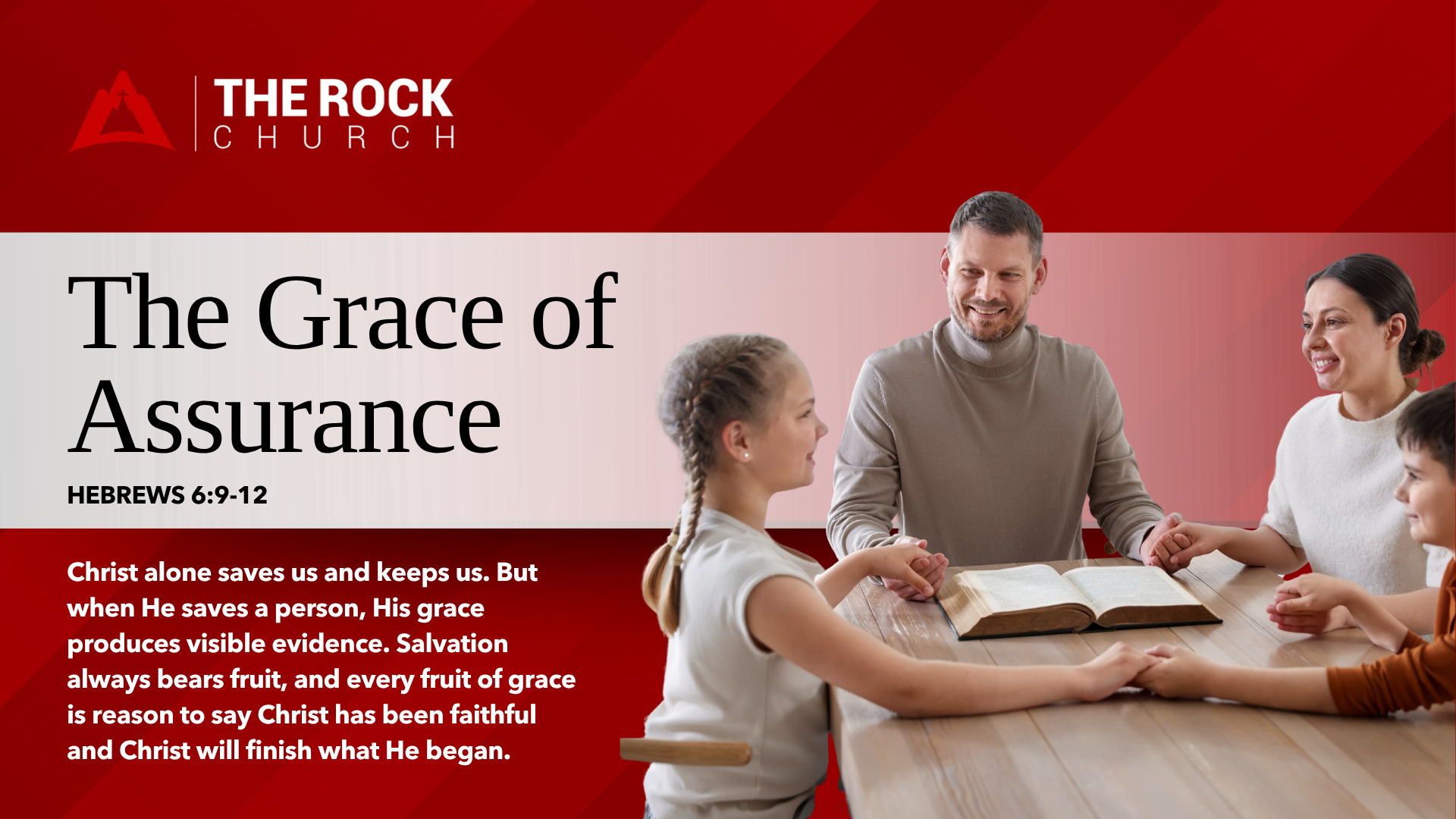
The following is a sermon transcript from our Sunday Service at The Rock Church in Mount Laurel, New Jersey. Each week, we gather to worship, learn from God’s Word, and grow together. This transcript is provided as a free resource to encourage and equip you in your walk with Christ. While you’re welcome to read and share this content for personal use, we kindly ask that it not be redistributed or published elsewhere without prior written consent from The Rock Church.
Introduction
Imagine driving down the road and seeing a thick column of smoke rising above the trees. You can’t see the fire itself, but you also don’t wonder if anything is burning. The smoke is evidence of a fire you cannot see. The smoke did not start the fire. It did not sustain the fire. But it reveals that the fire is there.
Something similar is true of salvation. Our good works do not cause our salvation, and they certainly cannot sustain it. Christ alone saves us and keeps us. But when Christ saves a person, His grace produces visible evidence. New love begins to burn within us. Our desires begin to change. We want to serve God’s people. And even through trials, faith keeps trusting, and hope keeps looking to Christ.
Spiritual fruit is not the fire of salvation, but it’s the evidence that the fire of God’s grace is burning within us. And the author of Hebrews has just given his own version of that illustration. The kind of crop the ground produces reveals what’s happening beneath the surface.
Last week, we saw that sobering contrast between two kinds of ground. Both receive the same rain, but only one produces a useful crop. And now in verse 9, the author turns from that heavy warning — anybody feel the weight of that last week? — to now this encouragement. He’s confident that better things concerning them, things that belong to salvation. And that brings us to the central truth of the passage: Christ alone is the ground of our assurance, and spiritual fruit is the evidence that strengthens that assurance, that confidence in our salvation.
The 1689 Confession summarizes this beautifully. Assurance is not mere guesswork or uncertain hope. It’s a settled confidence founded upon the blood and righteousness of Christ revealed in the gospel. It’s also strengthened by the inward evidence of the grace of the Holy Spirit at work within us.
Notice that order. Our assurance is founded upon Christ’s blood and righteousness. That is the unshakable ground upon which we stand. But our assurance, our confidence in salvation, is also strengthened as we see the Holy Spirit producing the fruit of His grace within us. Christ is the foundation. Spiritual fruit is the evidence. We never find peace by staring endlessly at ourselves. Our assurance rests upon Christ — who He is, what He’s accomplished, and what He’s promised. But we can also be encouraged when we see the evidence of His grace at work within us.
And in these four verses that we’re going to read, the author points us to that evidence. In verse 9, salvation always produces visible fruit. In verse 10, love for Christ is demonstrated by serving His people. In verse 11, hope grows into full assurance through something called continued diligence. And in verse 12, through faith and patience, believers inherit God’s promises.
Point 1: Salvation Always Produces Visible Fruit
Hebrews 6:9
So let’s begin with verse 9. Salvation always produces a visible fruit. Verse 9, let’s read it again. Though we speak in this way — remember, he was just hitting them hard. Though we speak this way, sorry, but not really — “Yet in your case, beloved, we feel sure of better things, things that belong to salvation.”
The author has just delivered, as I said, one of the strongest warnings in Scripture to the visible church, consisting of what? Both believers and unbelievers. And so a question naturally arises from our text. Does God want us to grow in assurance of our salvation, or does He want these warnings to leave us continually uncertain?
No. God wants His children to grow in assurance — not confidence in ourselves, but confidence in Christ. Christ is the ground. He alone is the ground of our salvation. He’s the ground of our assurance.
But there’s also something important we must also understand about saving faith. We are justified through faith alone — we all agree on that. But the faith that justifies is what? Never alone. Saving faith always produces fruit.
And notice how the author addresses them with such a severe warning. And then, beloved. That is a term of endearment. It expresses deep affection for the church of the living God. The author was not warning them because he wanted to condemn them. He warned them because he loved them. Love, when properly expressed, is always going to include the truth. And now, having spoken the truth plainly, he comforts them tenderly.
Though we speak in this way, yet in your case, beloved, we feel sure of better things, things that belong to salvation.
He’s not expressing wishful thinking. He’s not saying, “Hey man, I really hope it works out for you and all that you believe.” No, he possesses this settled confidence that better things are true of them. And what are these better things? They are the spiritual fruit that accompanies salvation — the love, the service, diligence, hope, faith, patience — the ones described here in verses 10 to 12.
You ever known someone who claims to be a Christian, but when you look at the person’s life, you struggle to see any evidence of saving grace? They claim to possess faith, but that faith never seems to have any companions hanging with it. No repentance, no love for Christ, no desire for holiness, no love for His people.
Now, we have to be careful here. We should not constantly be inspecting everyone around us, trying to decide, are they truly saved? No, God’s work of fruit bearing looks different in every believer. Some believers, they seem to grow rather rapidly. Others struggle forward slowly. Some bear fruit that’s immediately visible. In others, the fruit is small, it’s fragile, it’s easily overlooked. But fruit — listen — fruit is never the ground of our salvation. Christ alone is. And yet salvation always produces fruit.
That’s the contrast the author has presented with these two fields. The same rain falls on these two fields. One produces a useful crop, and the other, man, that’s just thorns and thistles. What grows above the ground reveals what was happening underneath.
And now the author, he looks at the church and says, in effect: Beloved, I’m confident — I’m confident that Christ is at work among you. I can see the evidence of His grace among your lives. Believe me, as a pastor, I see it. These are the things that accompany salvation. So don’t grow weary. Don’t stare endlessly inward, anxiously digging around the roots every day to see whether anything is growing. Look to Christ. Trust His promises. Continue walking with Him.
And then from time to time, look back over your life. Think about what the Lord has done for you. Think about sins you once embraced without a care in the world, but now grieve, confess, and fight. Think about the Savior that you once ignored — “I want nothing to do with that Jesus” — but now you desire to know more and more and more. Think about the ways that He carried you, He corrected you, He restored you, and He is keeping you.
The fruit may not be as abundant as you desire. Anybody want more fruit in their life? Sure, we all do. That’s not the question. The question is, is the fruit there? Do you see even the smallest signs of His grace? Tender conscience. Hunger for Christ. Grief over sin. Love for His people. A desire to obey. And a faith that, despite every trial, keeps coming back to Him.
Do not despise small fruit. Small fruit is not no fruit. And every genuine fruit of grace gives us another reason to say, Christ has been faithful to me. Christ is at work in me. And Christ will finish what He began.
And what is the first evidence of grace the author sees in them? Not extraordinary gifts. Not impressive knowledge. Not some dramatic spiritual experience. He sees their love. And that love has not remained hidden in their hearts. It’s taken a visible form: to serve Christ’s people.
Point 2: Love for Christ Is Demonstrated by Serving His People
Hebrews 6:10
That brings us to verse 10. Love for Christ is demonstrated by serving His people. The author begins verse 10 by directing our attention to the justice of God. Listen — for God, verse 10, “is not unjust to overlook your work and the love that you have shown for His name in serving the saints, as you still do.”
You know, we usually think of God’s justice in connection with His judgment, and rightly so. Every sin will be judged, either in Christ on the cross or in the sinner under God’s wrath. Every wrong will finally be made right. But here the author applies God’s justice in another direction. God will not overlook the work of His grace that it has produced in His people.
That does not mean that our obedience places God in our debt. Our works do not merit our salvation. Nor do they earn anything from God, as though He owed us something. Rather, God is faithful to His gracious promises. People forget. God never does.
Verse 10 says that they demonstrated love for God’s name in serving the saints. Their love for Christ became visible in their love for Christ’s people. And notice the final words that he says: as you still do. They had served the saints in the past, and they continue to serve them in the present. This is not some momentary burst of enthusiasm. No, their love, as it’s being displayed toward the saints, has endured. That’s one of the most beautiful evidences of grace — not merely that you served once, but that you continue to serve even when it becomes difficult.
Jesus says in Matthew 10:42, “Whoever gives one of these little ones even a cup of cold water, because he is a disciple, will by no means lose his reward.” Even a cup of cold water. It seems so small. I mean, who’s going to write a biography about a person who handed someone a cup of water? But God sees it. The smallest act of service done in Christ never goes unnoticed by Him.
The Christian life is a life of obedience — imperfect and mixed with weaknesses and sin, yet graciously accepted in Christ. God does not accept our works because they’re flawless. He accepts us in His beloved Son. And then He graciously receives that imperfect service that flows from our union with Christ.
And yet we often wonder, is what I’m doing really making a difference? Shouldn’t I do something bigger? Other people, they’re more gifted than I am. Maybe my little acts of service, it doesn’t even matter that much. But listen — success in God’s eyes is different than success in the world’s eyes. The world says, man, go big or go home. God says, be faithful. Be faithful in the small things. Be faithful when no one notices. Be faithful when there’s no applause. Be faithful, because your Father sees what is done in secret. And in Christ, your labor is never in vain.
So, is the Christian life then, is that all about collecting rewards? Well, certainly not. Love, not reward, is the great motive of Christian service. Scripture teaches that believers will appear before the judgment seat of Christ and receive what is due for their deeds. But even those rewards will be rewards of grace. As Augustine famously expressed it, when God crowns our works, He’s crowning the gifts of His own grace. The strength that you used to do that thing — that was His. The love that you shared for that unlovable one — yeah, that was His. That opportunity that came out of nowhere — that was His providence. And yet in His amazing grace, He receives and then rewards us for the work that He did. That’s pretty cool.
Remember that grace doesn’t make us passive. Grace makes us active. So what do we do? We consider the saints. We notice their needs. We serve them. We love them. And why do we serve? Because Christ loved us first and gave Himself up for us. The love of Christ is what compels us. It’s what motivates us.
Sometimes Christian service, I don’t know if you know, but it can be exhausting. Often it goes unnoticed. And most of it is wonderfully ordinary. But do not overlook the kindness of God in using weak, ordinary people like you and me. God delights to accomplish His work through the ordinary saints with their quiet acts of faithfulness. Beloved, keep serving. Keep loving God’s people. Don’t grow weary in doing good, for in due season you will reap if you do not give up. Did you hear that? Do not give up.
Later in Hebrews 10, the author reminds these Christians how they endured suffering, showed compassion to prisoners, even accepted the plundering of their property, because they knew they possessed something better and lasting. We’re going to see, many chapters later, their service was costly, but their love for Christ was visible in the way that they loved His suffering people.
What do we do for the least of these, Christ’s brothers and sisters? We do for Him. Christ Himself. So spur one another toward love and good works. The Christian life is not principally about being noticed or being served. It’s about following the Son of Man, who came not to be served, but to serve and to give His life as a ransom for many.
So examine your heart. Do you desire to serve Christ’s people? If there is no love for His church, no concern for other believers, no desire to bear anyone’s burdens, that should, yes, concern you. You may say that you love Christ, but if you don’t love His people, then something is wrong.
Now, don’t immediately spiral into fear. Stop and ask yourself a few questions. Have I been too focused on myself? Am I so wrapped up in my own needs that I no longer notice the needs of others? Is there sin in my life that has made my heart cold toward Christ’s people? And then, once you do that, once you ask some basic questions, then look again to Christ. Remember how He saw your need. Remember how He stooped down to serve you. Remember how He bore your greatest burden on the cross. And then ask Him to make His love visible through you.
Be encouraged. God remembers your work. He sees your love for His name. He sees every quiet act of service you offered to His people. People are going to overlook it. God never will.
Love for Christ is demonstrated by serving His people. But the author, he doesn’t want them to merely remember how they served in the past. He wants them to continue, to keep on going. The grace that produced love yesterday, it must keep bearing fruit today. But assurance does not flourish through spiritual passivity. As we continue to look to Christ, we trust His promises, we walk in obedience, and our hope becomes increasingly settled.
Point 3: Hope Grows into Full Assurance Through Continued Diligence
Hebrews 6:11
That brings us to verse 11. Hope grows into full assurance through continued diligence. It’s verse 11, we read together: “And we desire each one of you to show the same earnestness, to have the full assurance of hope until the end.”
Look, the author, he begins this, really, by expressing — this verse 11 — expressing his pastoral affection for the people of God. See that? “We desire each one of you.” That doesn’t sound like a cold command of a harsh taskmaster. It sounds like the earnest longing of a shepherd’s heart. He deeply desires every believer in this church to experience the full assurance of hope. And through this inspired appeal, we see that God desires, wants us to enjoy this full assurance.
He doesn’t intend the Christian life to be this unending cycle of asking constant questions about, am I really saved? Have I produced enough fruit? Does God really love me? None of us has produced enough fruit to make ourselves acceptable to God. Christ alone saves us. It’s His righteousness that’s sufficient. And He will keep everyone who truly belongs to Him.
The Father did not begin loving us after we believed. Did you know that? The cross did not persuade an unwilling Father to love us. The Father gave up His Son because He loved us. And that love reaches back before the foundation of the world and stretches forward to all eternity. And because of that eternal love, as it worked within us by the Holy Spirit, the author desires us to grow in what he calls this full assurance of hope.
Full assurance is settled confidence. Confidence in what? The certain confidence of final salvation. Ask someone on the street whether they expect to go to heaven. What do they say? “Well, I hope so. I think I’m a good person.” That is not biblical hope. That is uncertainty resting upon human performance. Biblical hope is confident expectation resting on the promise of God and the finished work of Christ. It does not say, perhaps God will save me if I’ve done enough. It says, Christ has accomplished salvation. God has promised it. And therefore, I confidently await its completion.
But notice the author connects this full assurance with diligence. Isn’t that interesting? “We desire each one of you to show the same earnestness, to have full assurance of hope until the end.” Diligence does not make God’s promises true. Diligence does not add anything to Christ’s finished work. But spiritual passivity will not ordinarily produce strong assurance. If we neglect the Word, if we withdraw from God’s people, start to tolerate sin, no big deal, prayer when I have time for it, cease serving the Lord and His people — we should not be surprised when our assurance weakens.
Assurance ordinarily flourishes as we look to Christ, as we engage in the ordinary means of grace, as we fight sin actively, serve His people actively, continue walking in obedience.
Philippians 2:12–13: “Work out your own salvation with fear and trembling.” Why? “Because it is God who’s at work in you, both to will and to work” for what? “His good pleasure.” Our diligence is not an attempt to complete what Christ left unfinished. Don’t hear me that. It is the fruit of God’s gracious activity within us. Christian hope is active, trusting hope.
Hebrews 10:22 says, “Let us draw near with a true heart in full assurance of faith, with our hearts sprinkled clean” — okay, Presbyterians — “from an evil conscience, and our bodies washed with pure water.” Where does that assurance come from? From drawing near to God through our great High Priest. Our conscience has been cleansed because the blood of Christ has answered our guilt.
We do not approach God pretending we have no sin — “I got this, Lord. I’m doing fine. Nothing to talk about. Everything’s great.” We approach with the knowledge that Christ has fully dealt with our sin. We are accepted in the Beloved. So do not spend your Christian life endlessly wondering whether Christ is enough for you. Did He accomplish enough? Is really all my sins forgiven? He is enough.
So don’t confuse diligence with an attempt to earn God’s love. That’s not what we’re talking about. You pursue Christ because God has already loved you in Christ. So continue in His word. Continue in prayer. Continue gathering with the saints. Continue fighting sin. Continue serving Christ’s people. And do this all until the end.
As you diligently pursue Christ, your hope does not become more objectively certain. God’s promises are always certain. But your enjoyment of that certainty deepens. Your hope grows toward full assurance. Hope grows into full assurance through what? Continued diligence. You see that?
But the Christian life is not about starting well for a little while. It’s about continuing to trust Christ when the promises, they seem very far away. God’s timing, painfully slow. That’s why the author does not merely call us to diligence. He points us to those who kept believing — those that have gone before us, those that waited until they received what God has promised.
Point 4: Through Faith and Patience, Believers Inherit God’s Promises
Hebrews 6:12
That brings us to verse 12. Through faith and patience, believers inherit God’s promises. Verse 11 — verse 12, sorry, verse 11: “So that you may not be sluggish, but imitators of those who through faith and patience inherit the promises.”
You see, the author now returns to the danger that he had once brought on. Remember that, chapter 5, verse 11 — “that you may not be sluggish.” The word translated sluggish is the same as the one translated dull, in the phrase “dull of hearing.” It describes spiritual laziness, a passive, unresponsive heart that has become slow to hear and slow to obey. And spiritual sluggishness, it never strengthens our assurance. It does quite the opposite. Assurance weakens when we retreat from the ordinary means that God has given us and allow ourselves to be drawn away by the desires of the flesh and the ways of the world.
So what is the cure for spiritual sluggishness? Maybe you’re feeling that way now. Keep the end in view. Don’t live as though this present world is all that there is. So much of our attention is consumed by temporary concerns. What do I need? What do I want? What will make me feel happy? What will make my life complete? But the world is passing away. Everything we own will one day be left behind. Everything pursued apart from Christ and His glory will finally amount to nothing.
The faithful saints valued God’s promises above earthly comfort. That’s why the author tells us to become imitators of those who through faith and patience inherit the promises. Christian perseverance, Christian pressing on, is not some solitary project. God has given us faithful saints to imitate. In the very next verse, the author begins with Abraham, who patiently waited and obtained what God had promised. And later in Hebrews 11, he’ll introduce us to many more. By faith, Moses chose to be mistreated with the people of God rather than to enjoy the passing pleasures of sin. By faith, Joseph spoke about the exodus before it occurred and gave instructions concerning his bones. By faith, Isaac pronounced future blessings upon Jacob and Esau. They lived in the present, with their eyes fixed upon what God had promised for the future.
And perhaps you have personally known saints just like that. Men and women who walked with God for decades. They’ve endured suffering, buried people they loved, experienced disappointment, and faced their own death, yet continuing to trust that God had prepared something better for them. Jesus promised this: “I go to prepare a place for you. And if I go and prepare a place for you, I will come again, and I will take you to Myself.” He has not forgotten His people. He will bring us home. And the author tells us to imitate believers who live with that confidence.
That means it matters who shapes our lives. Spend time with seasoned saints. Listen to the people who have learned, in suffering, that Christ is faithful. Let the fellowship of God’s people be very sweet to you. I think of faithful encouragers who help others look to Christ and remember His goodness. Spend time with saints like that. We need each other. If our closest influences continually direct us to self-fulfillment, earthly comfort, and our supposed right to get everything we want, we should not be surprised when our hearts become increasingly attached to this world. But faithful saints remind us of this: Christ is better. His promises are certain. His kingdom is coming.
So imitate their faith. Faith trusts what God has promised even when you cannot see it. Hebrews 11:1 says, “Faith is the assurance of things hoped for. It’s the conviction of things not yet seen.” We would not need faith if everything promised was already visible. One day faith will become sight. But until that day, keep trusting the Lord. Listen — God has never been late, careless, or unfaithful to any of His promises.
And faith expresses itself through patience. Patience here is not passive resignation. It’s long-suffering endurance. It’s continuing to trust when the answer has not come. It’s continuing to obey when the road ahead is painful. It’s continuing to wait when God’s timing, it just seems painfully slow. You know this — the Christian life is a marathon, not a sprint. So fix your eyes on Jesus, the author and the finisher of your faith.
The saints inherit the promises through faith and patience — not because their endurance earns their inheritance, but because persevering faith receives what grace has promised. Our inheritance is entirely a gift. When we finally stand before Christ, none of us will say, “I endured long enough. Now, Lord, You owe me.” Oh, no.
Conclusion and Application
So as we close, return with me, if you would, for a moment to that column of smoke rising above the trees. The smoke didn’t start the fire, and it did not keep the fire burning, but it revealed that the fire was there. In the same way, our love, our diligence, our faith, patience do not save us or keep us saved. Christ alone does that. But these are gracious evidences that Christ is at work within us.
So when you see even small fruit, don’t boast in yourself. Give thanks to Christ. When you struggle to see any fruit, don’t look inward constantly, looking at those roots, trying to dig them up. Look again to Christ. And when that road is long and God’s promises seem distant, keep trusting Christ. He’s the ground of our assurance. His grace is producing the evidence. His faithfulness will carry us to the end.
We are not saved because we endure. We endure because Christ has saved us. Christ is keeping us and Christ will bring us home.
Brothers and sisters, Christ is keeping us. Christ will bring us home. But as we consider the fruit that accompanies salvation, we must also confess that our lives often fall short. We have been sluggish when we should be diligent. We’ve neglected opportunities to serve Christ’s people. We’ve placed our hope — I know I have — in the passing things of this world rather than the promises of God.
So what I want us to do together is come before the Lord — not to earn His mercy, because that’s not what mercy is, but because mercy has already been given to us in Christ. Let’s do that now.
Closing Prayer
Merciful Father, You have loved us in Christ with an everlasting love. And yet our hearts have often grown cold. You’ve called us to serve Your people, yet we are consumed with ourselves. You’ve given us every reason to hope, yet we have surrendered to fear and unbelief. You’ve called us to diligence, yet we’ve often been spiritually sluggish. You’ve given us certain promises, yet we have lived as though this passing world were our true home.
Forgive us, Father. Forgive our lovelessness, our selfishness, our worldliness, and our unbelief. Cleanse us from every sin with the blood of Christ. Renew us by Your Spirit. Produce within us the fruit that accompanies salvation. Teach us, oh great God, to love Your name, serve Your people, pursue Christ diligently, and wait patiently for the fulfillment of every promise.
We ask this in the name of Jesus Christ, our Savior. Amen.
Ready to Take Your Next Steps at The Rock Church in Mount Laurel?
The Rock Church in Mount Laurel, New Jersey exists to help people know God, follow Jesus, and make disciples who multiply. Whether you’re new or already part of our church family, we’re here to help you stay connected! Plan your visit to experience a Sunday with us, or download the Church Center App to stay updated, join a group, register for events, and more.