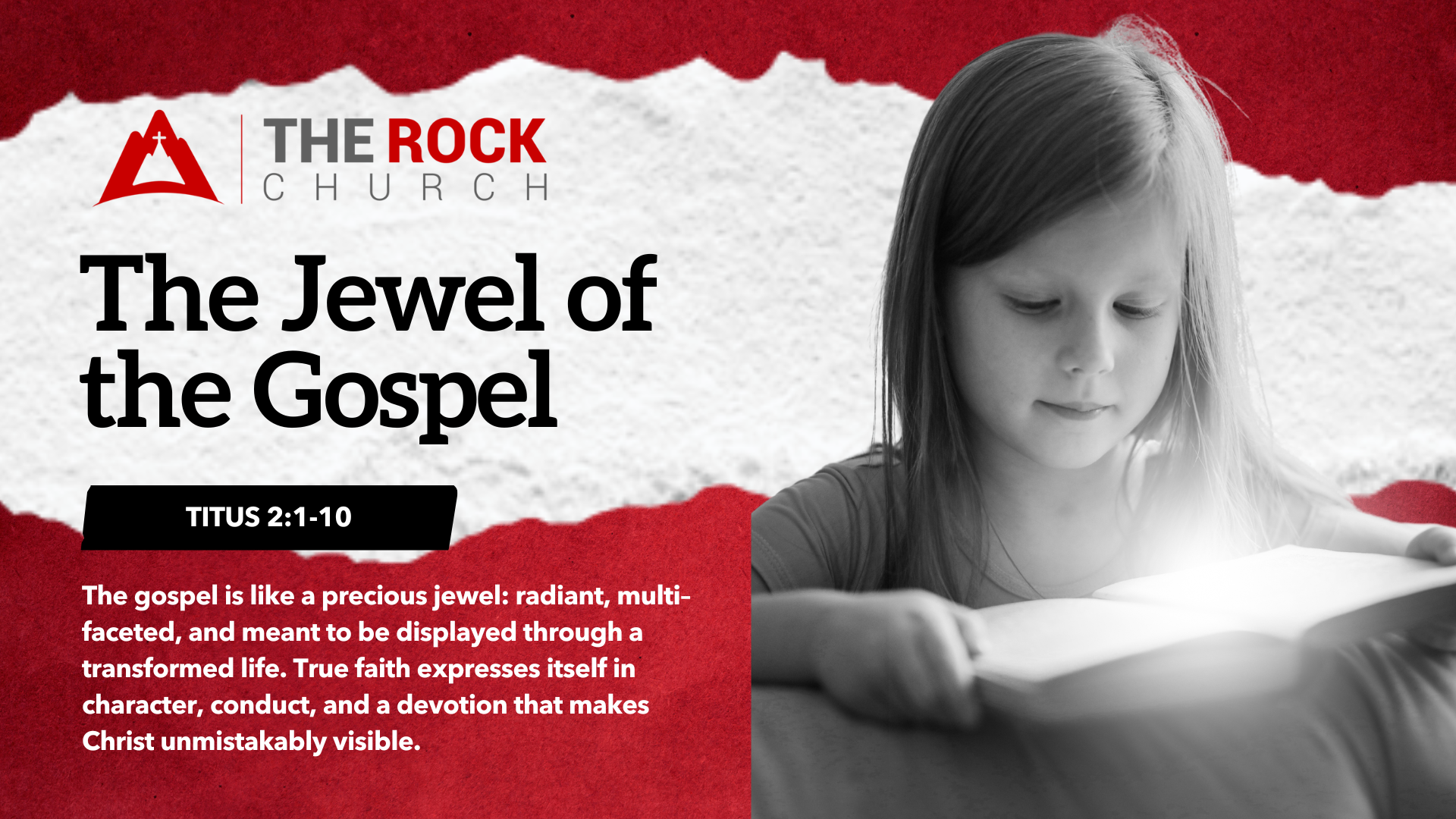
The following is a sermon transcript from our Sunday Service at The Rock Church in Mount Laurel, New Jersey. Each week, we gather to worship, learn from God’s Word, and grow together. This transcript is provided as a free resource to encourage and equip you in your walk with Christ. While you’re welcome to read and share this content for personal use, we kindly ask that it not be redistributed or published elsewhere without prior written consent from The Rock Church.
Introduction: The Gospel as a Precious Jewel
Thanksgiving Day is just four days away. Can you believe that? This wonderful time for families to get together, to thank God for his every blessing — mashed potatoes, stuffing, cranberry sauce, and of course, the all-important turkey. After laying out all the elegant flatware and special dishes, it’s time to present the bird. But something’s missing. What is it?
Ah, yes — the garnish. The fresh herbs, the colorful fruits that transform what was an average turkey into something elegant, full of vibrancy and visual appeal.
A garnish serves in much the same way as fine jewels. A simple outfit is elevated into elegance by the careful placement of these precious jewels.
Now, I’d like us to consider the gospel as a jewel — an invaluable stone with many facets of beauty. It’s the immeasurable riches that we have in Christ: forgiveness of our sin, a right standing with the Holy God, the seal of His Holy Spirit in us, and of course, the hope of everlasting life.
The gospel is the believer’s adornment. No, it’s not wearing our faith on our sleeves by sporting some Christian t-shirts and crosses around our necks. It’s so much more than an elegant garnish or a precious jewel. Now, I’m not saying there’s anything wrong with wearing Christian symbols in Scripture — these can lead to very meaningful gospel conversations.
But how do we wear the gospel with our lives and our actions? I’m not saying that we need to preach the gospel and then, if necessary, use words. No, no. In fact, St. Francis of Assisi never said it. It was Duane Litfin, the president emeritus of Wheaton College, who said, “It’s simply impossible to preach the gospel without words. The gospel is inherently verbal. And preaching the gospel is inherently verbal behavior.”
However, our lives can lend themselves toward an opportunity to proclaim the gospel — or away from that opportunity to do such.
The early church father Chrysostom said, “The heathen do not judge the Christian’s doctrine from the doctrine, but from his actions and his life.”
It was Paul’s concern as he wrote his letter to Titus. The church has got to look different than the world — those lying, lazy, evil beasts of Crete. Love saying that. They were known for their wicked behavior — base in every sense of the word. And if there is any hope for this gospel to spread, certainly it must be first displayed as a jewel in the life of the believers.
“Well, those Christians — they have a different work ethic. Their homes are perfumed with love. The soundness of their teaching shines through their hearts. They exercise self-control. They’re not given over to every impulse and desire of their heart. There’s something different about them. I just can’t put my finger on it. There’s something — they’re certainly not perfect, but they have something that I really want.”
You see, it’s really easy as Christians to get all torn up, to be writing page upon page of theological treatises, to fight endlessly online over secondary matters of doctrine. And of course, you gotta be right — at every cost. But how many are willing to live for their faith? That’s right — not die for their faith. Live for their faith. That is really the hardest part.
And that’s the theme that continues as we make our way through this letter to Titus.
It would be very easy, as I read the Scripture, to give you the law. “Oh yeah, dear saint, you better watch out what you say. You better exercise self-control.” Wagging my finger. “You better think carefully about how you act and how you are perceived.”
Now, to be clear, I’m not saying these things don’t matter. What I am saying is: What is the basis for these commands? Well, it goes back to what I’ve said before — the imperatives, remember, what we must do, the commands? Those imperatives without the indicatives — what is true — if they’re not together, it’s like having the fastest car, but never getting to drive it.
That’s right, Duncan. You’ll never get to drive it. It’s powerless. It’s behavior above identity. It’s the forceful correction without a firm foundation. It’s always using the rod of rebuke and never the loving arms of embrace.
With that being said, I’d like to present our big idea:
Big Idea:
The gospel shines like a precious jewel when believers show consistency between their convictions and their character.
This is important stuff. And here are four ways the gospel is adorned as a beautiful jewel in the lives of believers:
- In the elders — through sound teaching, wholesome speech, faithful living.
- In the older believers — through demeanor and devotion.
- In the younger believers — through restraint and reverence.
- In the believing employees — through obedience and allegiance.
1. The Jewel of the Gospel Through the Elders
Titus 2:1; 7–8
Verses 1 and then 7–8 direct Paul’s words to Pastor Titus — and by reflection, to the elders of the church:
“But as for you, teach what accords with sound doctrine… Show yourself in all respects to be a model of good works, and in your teaching show integrity, dignity, and sound speech… so that an opponent may be put to shame, having nothing evil to say about us.”
For the elders in the church — most importantly, but certainly for any believer — it’s three things: what you say, how you say it, and how you live it out.
As I said before, we can have all the right doctrine, the carefully crafted statement of faith, all the creeds and confessions. We can study these things. We can memorize them. We can be knowledgeable about all the finer points of doctrine. But if we come across as domineering, as arrogant, it really doesn’t matter what’s written on those documents — because we have demonstrated very clearly that the fruit of our theology is rotten and moldy.
As one commentator put it, our theology can either be maimed or diseased.
If it’s maimed, that means bits of it are missing.
If it’s diseased, that means bits of it are distorted.
This is why we must remain committed to the final authority — the whole counsel of God’s Word. When I say whole counsel, I mean all 66 books, every verse, every section. This is why when I come to the text, it is so important to look at the original language, to understand the context, and to pick up on the nuances from one verse to the next.
Recently, I was reading about the heretical Passion Translation. The author, Brian Simmons, declared that Jesus had given him a special anointing and calling. He claimed he was inspired to write what he thought was another translation of the Bible.
Somehow he discovered that the original writings of the New Testament — oh no, not in Greek — they were Aramaic.
Really? That’s amazing, Brian.
You’re the only one, of all the scholars, who has discovered this amazing fact?
That’s right.
And worse yet, this man, notably of the New Apostolic Reformation (the NAR), ventured on this all-important endeavor all by himself. Solo operation.
Tons of red flags appear when it comes to the Passion Translation. First, it’s not a translation. It’s not even a commentary. Simmons infuses NAR theology into the Word of God. He elevates his error to the level of the true and incorrupt Scripture.
What’s an example of this destructive theology? There are many.
For example, John 14:12 — he butchers what Jesus declared by saying:
“The person who follows me in the faith, believing in me, will do the same mighty miracles that I do — even greater miracles than these.”
At first glance, someone might think, “Well, that sounds biblical.”
But the Greek word for miracles is NOT there. It is works.
Jesus was not saying, “You will out-miracle me.”
He was saying that as the gospel goes forth through the Church, it will have a far-reaching, global impact — greater in scope, not in supernatural power.
This NAR interpretation is blasphemous because it implies equal or greater divine ability than Jesus Himself.
So much more could be said about this false prophet, Brian Simmons. But sadly, this heretical “translation” finds its way into common platforms like YouVersion and Logos.
Paul makes it very clear — Titus must teach that which accords with sound doctrine.
Sound doctrine is that which is faithful to the Word of God; healthy, true, uncorrupted. It points us to Christ — not to your best life, not to your dreams, not to self-fulfillment — to Jesus.
It elevates the glory of God and lowers man.
It is holistic — not wincing at sin, corruption, wrath, or the reality of hell.
It lifts the downcast and humbles the proud.
It is not the New Testament only, unhitched from the Old.
It is the beautiful tapestry of all Scripture woven together — the fullness of divine revelation building up the church into the head, who is Christ.
The standard for the teacher is higher.
James 3:1 says teachers will be judged with greater strictness. Why?
Because the judgment comes from the greatest Judge — Christ Himself.
For the false teacher who leads astray the people purchased by the blood of Christ — this is grave danger.
But it’s not only what is said; it’s also how it is said.
Paul tells Titus to be sound in speech — not deviating from the truth, and communicating that truth in a way that is wholesome, fit, and wise.
Wholesome speech is the opposite of the false teacher’s speech.
The false teacher crushes, wounds the conscience, and defiles the spirit.
Wholesome speech builds up, is kind and gracious, speaking truth in love.
This applies both publicly and privately.
He can be a great Bible expositor in public, but something different in private — legalistic, crushing. That is not the jewel of the gospel.
Proverbs 16:7 says,
“When a man’s ways please the Lord, He makes even his enemies to be at peace with him.”
While we don’t seek to win the world’s friendship, our enemies should have nothing evil to say about us.
Yes, the gospel will offend — but the way we carry that truth must not be offensive. There is an approach that matters.
Sadly, the world has many evil things to say about Christians. Scandals, controversies, power abuses — they stain the witness of the Church.
Ephesians 4:29 says:
“Let no corrupting talk come out of your mouths, but only such as is good for building up… to give grace to those who hear.”
Corrupting and divisive speech tears down. It destroys unity.
When disagreements on secondary matters turn into anger, disgust, or hatred — we have lost. The church gains nothing.
We must fight for the unity of the Spirit in the bond of peace — always.
So it’s what you say, how you say it, and how you live it out.
It’s much easier to die for your faith than to live for it.
Paul tells Titus to be an example to the church. The members need to see leaders modeling the Christian life.
Leaders are not perfect — far from it. They have the same struggles. They must be transparent. Their challenges at home and in the church are learning opportunities that point all of us to Christ.
The jewel of the gospel shines brightly when the church sees the faithful living of these elders — integrity, dignity, wholeness. Not one way in public, another way at home.
It begins in the mind.
What is his thought life?
How has the incorrupt Word penetrated his heart?
How does he handle conflict?
Is it an opportunity to force authority?
Or to lead with grace?
The jewel shines in the clear consistency between conviction and character.
2. The Jewel of the Gospel Displayed in Older Believers
Their Demeanor and Their Devotion
Titus 2:2–4a
“Older men are to be sober-minded, dignified, self-controlled, sound in faith, in love, and in steadfastness.
Older women likewise are to be reverent in behavior, not slanderers or slaves to much wine. They are to teach what is good, and so train the young women…”
Just because a believer is older in age does not mean that he or she is mature in the faith.
But assuming that’s the case — in contrast to the culture of Crete — what is the exhortation?
Notice what should happen in the life of the older believers: as they have gone through the myriad of trials and tribulations, what has happened?
The gospel has seasoned them.
It has borne fruit.
It has settled their hearts.
It has brought them to a place of rest — trusting that God is working all things together for their good and His glory.
It is this steady, level-headed posture.
All the craziness in the world, all the winds and waves even in the church — but they’re steady.
That’s what it means to be sober-minded — temperate in their thinking.
They see all the doctrines swirling, all the controversies raging — and they simply trust the Lord. Slowly, steadily, faithfully living it out. They’re not given to speculation and sensationalism.
Notice the threefold characteristics of this older man:
- Faith
- Love
- Steadfastness
You will see the fruit of the Spirit ripening through the trials they’ve overcome.
And you’ll notice how these three correlate with faith, hope, and love from 1 Corinthians 13.
It is their right relationship with God, which leads to right relationships with others, and then produces a right understanding of the certainty of eternal life.
His sound faith produces sound love.
Sound love produces sound steadfastness.
He is unswerving, keeping his focus on the purposes of God in Christ for his life.
Chapter 17, paragraph 2 of the confession tells us that this perseverance — this steadfastness — does not depend on our own free will… but on the unchangeableness of the decree of God.
It flows from the free and unchangeable love of God the Father.
Does that encourage you?
We talked about this last week — God’s impassibility.
His love is constant.
Not fluctuating from bad mood to good mood.
This is good news for believers.
Because our perseverance is rooted in Christ’s intercession and the Spirit’s abiding presence in us.
Our certainty to persevere is based on God’s certainty to preserve us.
This is His oath.
His promise.
His Spirit.
His covenant of grace.
It is not a conditional promise —
“Keep your end of the deal or I’ll yank salvation away.”
No.
The covenant of grace is God-initiated, God-sustained, God-guaranteed.
And many of these same traits apply to the older women.
Their demeanor.
Their devotion.
Their demeanor — how they carry themselves.
In the original language, “reverent in behavior” refers to a woman who considers all of life sacred.
She is like a priestess in her consecration to God.
Her home is sacred.
Her community is sacred.
Her workplace is sacred.
All of it is lived before the face of God.
The Reformers called this coram Deo — living with the active awareness that God is present everywhere, all the time.
So the last thing a godly older woman wants is to be part of gossip or drunkenness — the very things common in Crete and just as common today.
Then comes the special directive:
“They are to teach what is good. And so train the young women…”
Instead of Titus teaching the younger women directly, Paul essentially says:
Titus, talk to the older women. Let them do this. This is not appropriate for you. Let them step in and train the younger ladies.
And the reasoning is obvious.
Just this past week, Reformed Baptist pastor Samuel Renahan resigned due to adultery. It was a sobering example of a man with correct doctrine whose life did not match it. It is fitting and wise that older women lead in teaching younger women.
What should they teach?
Exactly what Paul lists:
- Loving their husbands
- Loving their children
- Being temperate and pure
- Being kind
- Being submissive to their husbands
(I’ll address that word submissive shortly.)
Now — some say that this passage forbids women from teaching other women publicly. They argue this is only private instruction.
Personally, I disagree.
There is public teaching (Sunday morning gathered worship)
and private teaching (home, small groups, women’s gatherings).
A women’s ministry on a Saturday afternoon is not the same as the Sunday pulpit.
Scripture forbids women from exercising authority over men in the gathered worship (1 Timothy 2:12) — but not from teaching women.
Thus, it is good and right for older women to teach younger women — in groups, in homes, in Bible studies, in mentorship — all for the good of the church.
And through this,
the jewel of the gospel shines in the demeanor and devotion of mature believers.
3. The Jewel of the Gospel Displayed in Younger Believers
Their Restraint and Their Reverence
Titus 2:4b–6
“…to love their husbands and children, to be self-controlled, pure, working at home, kind, and submissive to their own husbands — that the word of God may not be reviled.
Likewise, urge the younger men to be self-controlled.”
Before you get the wrong idea of what Paul is saying here in verse 5, allow me to clarify:
Paul is not saying that women must only stay at home.
There is no clear prohibition against women pursuing careers.
What he is cautioning against is pursuing career at the expense of the home.
Wives should be home-lovers — active in the duties and responsibilities contained therein.
Now husbands —
this does not mean you are exempt from your duties in the home.
Let me tell you — when you get home today, pick up that vacuum, throw some things in the laundry… get ‘er done.
What should be apparent in the wife is a kind heart — loving and hospitable. She opens her home freely, for the benefit of the church and even the community.
And she understands her relationship to her husband — she submits to him in the same way she submits to Christ.
This is the proper order that God has set.
It is not an excuse for the husband to demand respect, to lord it over his wife, or to tempt her to sin.
No — the home that is “perfumed with love” contains a wife who joyfully submits to her husband because her husband loves her. Because he loves Jesus. Because he seeks to love his wife as Christ loves the church and gave Himself up for her.
As Alfred said:
“Loving your husband is the foundation of all domestic happiness.”
But that same love applies to the children.
Mothers naturally have a maternal love that is different than fathers. But how does the world understand this? How does the culture form its view of childhood, parenting, home?
The great benevolent interweb — sarcastically speaking — offers all kinds of wisdom. One example is the “7-7-7 Rule”:
- Seven minutes in the morning
- Seven minutes after school
- Seven minutes before bedtime
Affirmations, conversations, focused attention…
Now, I’m not opposed to giving proper care and focused attention to children. But the question is:
What is the content of that care?
The rhythm of morning and evening is woven through Scripture.
Deuteronomy 6:7 says:
“You shall teach them diligently to your children… when you sit in your house, when you walk by the way, when you lie down, and when you rise.”
Teach them what, pastor?
To love the Lord their God with all their heart, soul, and mind.
And that’s where family worship comes in.
“What is family worship, pastor?”
It’s a simple tool.
I recommend Joel Beeke’s Family Worship Bible Guide. Read ten verses, read the short commentary, ask one question, engage your children, sing one song. Keep it simple. It’s a guide.
As a church, we can buy them for you.
And as I’ve said, the ministry of the home is one of the highest priorities — not just for leaders, but for the whole church.
A Christian home in shambles — disorder, chaos — brings reproach on the gospel. It is a sobering reality and a reminder that our families need Jesus.
Now — I am not saying that doing family worship guarantees a perfect home.
“Dear brother and sister, if you do family worship twice a day, you will have no problems.”
No — that would become law.
“I have to do this. Pastor said I must do this.”
Duty — not delight.
Start somewhere — even once a week.
Start small.
It is difficult.
The culture fights against it.
We live in a world where busyness is equated with value.
More activities means more meaning… allegedly.
Yet the opposite often happens:
tired, weary, overscheduled, underpaid.
Maybe we need to take a step back:
“I’m going to take some things out of my life.
For one moment, instead of preparing my child to be a professional athlete, maybe I should think about their soul.”
What if we prepared the next generation of church leaders?
What if we grounded them in who they are in Christ?
What if we trained them in the richness of God’s Word?
It would transform communities.
Instead, we see fatherless homes.
Rebellious children.
Brokenness everywhere.
So the attention shifts to younger men.
“Oh pastor, Paul seems misogynistic. He lists all this stuff for the younger women, but to the younger men he only says… one thing. Be self-controlled.”
Chrysostom said:
“Nothing is so hard at this age, younger men, as to overcome pleasures and follies.”
Men in our nation are struggling with identity and purpose.
They’re told that biblical masculinity is toxic.
They’re confused, aimless, untethered.
What they need is the older men.
Older men — pray for the younger men.
Meet with them.
Teach them.
Open your lives to them.
They desperately need your presence, your wisdom, your example.
The future of the church is shaped by the next generation of young men.
Will they know Christ from all Scripture?
Or will they see the church as entertainment, moralism, or spiritual therapy?
The church needs reformation.
It must return to the Word — to the ancient paths.
Recover the riches of Christ from all of Scripture.
Understand the distinction between law and gospel.
Show young men that God loves them, sent His Son for them, rose again, intercedes for them.
And as younger believers see older believers steady, joyful, and rooted — they say:
“I want that. I want to be settled. I want to take all this energy and focus it on Christ. Build His church. Proclaim His gospel.”
It is here that the jewel of the gospel shines —
in younger believers whose lives are marked by restraint and reverence,
not by mere rules,
but by the modeling of those older in the faith.
4. The Jewel of the Gospel Displayed in Believing Employees
Their Obedience and Their Allegiance
Titus 2:9–10
“Bondservants are to be submissive to their own masters in everything;
they are to be well-pleasing, not argumentative, not pilfering, but showing all good faith,
so that in everything they may adorn the doctrine of God our Savior.”
“Well, pastor, you mentioned employees. I don’t see employees here. I see bond slaves.”
Yes — there is a cultural difference.
Slavery was tragically common in Paul’s day.
But this does not mean Paul endorsed slavery — far from it.
And, historically, it was Christians who led the way to abolish it.
But the concept of a bondservant is functionally similar to that of an employee.
(Some employees may even feel like their job is slavery — but I won’t go there.)
Children — listen up, too.
Just because you don’t receive a paycheck doesn’t mean you are exempt from this discussion.
You have duties in the home — and these principles apply to you.
What was happening with the bondservants who became Christians?
They thought they were now on the same level as their believing masters.
So instead of honoring them, they viewed them as peers.
Paul corrects this.
Whether you work at home, in an office, in a trade, in a company — the point is clear:
Obedience and allegiance are essential marks of a Christian’s witness in the workplace.
Am I saying employees should obey their bosses blindly?
“Pastor, what about unethical things? Fudging numbers? Illegal activity?”
Of course not. Absolutely not.
Assuming your boss is generally ethical, you should work unto him or her as unto the Lord.
The point is this:
Christian employees should look different.
Your boss should say:
“Wow… those Christians.
They show up early.
They work hard.
They’re honest.
They’re dependable.
They’re faithful.
What a breath of fresh air in today’s job market.”
This does not mean being a people pleaser — only working hard when the boss walks by and then scrolling your phone when he’s gone.
Paul says believers must not be:
- Argumentative
- Pilfering
- Lazy
- Undermining
Pilfering isn’t just stealing office supplies — it includes stealing time.
Studies show the average employee wastes over two hours of an eight-hour workday:
- Endless internet browsing
- Social media scrolling
- Water-cooler gossip
- Phone games
Instead, Paul calls for good faith — honesty, integrity, fairness, true effort.
And why?
Not so you can advance your career.
Not so you can feel good about yourself.
Not so you can impress the boss.
But so that:
“…in everything they may adorn — display — the doctrine of God our Savior.”
The gospel should look beautiful through your work ethic.
When you complain, lie, cut corners, gossip, or undermine authority —
the jewel of the gospel looks dim and dingy.
But when you work with integrity, diligence, and joy —
the jewel shines brightly.
We often forget the power of the gospel not only to save,
but also to sanctify every part of our lives — even the workplace.
All of life is sacred.
All of life is lived before the face of God.
We desire to love and serve the Lord, longing for opportunities to show the jewel of the gospel to the lost.
But if our character is inconsistent —
if our life contradicts our doctrine —
the jewel loses its shine.
No — the gospel shines like a precious jewel when there is consistency between conviction and character.
Conclusion
Consistency Between Conviction and Character
We don’t seek to live upright lives so people will say:
“Oh, you’re such a good person.
You’re so holy.
You’re doing so well.”
No — we live upright lives so the world will say:
“How great is their God.”
“How powerful is their Savior.”
“That must be Christ living in them.”
Otherwise, He would have taken us to heaven already.
Why else endure trials, hardships, difficulties?
To form Christ in us.
So the world sees Him — not us.
That’s why He ordains all things that come to pass —
both the painful and the joyful.
This is why prosperity theology is so sickening.
It denies the way Christ conforms us to His image through suffering.
When you disagree with your boss —
how will you respond?
Are you going to storm into their office angry,
armed with printed research,
ready to explode?
Or will you joyfully submit to the authority God has placed in your life?
The order is His.
The glory is His.
May our homes be perfumed with love.
May our churches be perfumed with love.
That the world may see our love for one another
and know that we belong to Christ.
Not marked by controversy,
division,
hatred,
secondary warfare —
but by biblical unity.
Knowing the primary truths,
and having charitable, humble discussions on the secondary ones.
Closing Exhortation
It is the love of Christ that compels us — not the law.
The law does not give power.
The gospel does.
Not the love of the law — but the love of the One who fulfilled it.
Before we knew Christ, our lives were marked by darkness and misery.
But now we have seen the great light.
We behold His glory in the face of Christ.
Keep looking to Jesus.
Not to controversies, myths, distractions, endless speculations.
All the struggles and trials remind us:
“You can’t do it.
I can’t do it.
But Christ can.”
And His power is made perfect in weakness.
So go to Him.
Confess what He already knows —
pride, selfishness, bitterness, anger, division.
Older men — go to the younger men.
Encourage them.
Lead them.
Model Christ to them.
Older women — train the younger women.
Model Christ to them.
All of us — let the jewel of the gospel shine.
Here is the full closing prayer, formatted to match the rest of the sermon and kept 100% verbatim with corrected punctuation only.
Closing Prayer
Lord, we confess our own selfishness, our own pride.
Lord, we often try to get our own way. We often think about ourselves before we think of others.
And we come across unloving, ungrateful.
So would You show us Your love, Lord Jesus?
By the power of Your Spirit, would You show us even now —
that we would know the depths of Your love,
the height of it, the width of it, the breadth of it.
A love so great that before the foundations of the world
You set apart this plan to redeem a people for Your own possession.
And now we safely trust in You, Jesus.
We safely rest in You.
We bow before You.
We lower ourselves.
We humble ourselves under the mighty hand of God.
And we know that You will build us up.
But it’s Your power, Your strength, Your Spirit.
So thank You, Lord, that You long-suffer with us —
a disobedient, obstinate people, prone to leave the God we love.
Lord, draw us back in by Your love.
And for anybody that’s here that doesn’t know the love of God
in the person of Christ, would You show them now?
Would You open the hearts of their understanding
to the knowledge of Christ?
Would You take away the blinders from their eyes?
Would You breathe life into them?
Regenerate their hearts.
Cause them to be born again.
That’s our prayer and our hope —
and we trust that according to Your sovereign plan,
You will do that.
Thank You, Lord, that You motivate us toward evangelism,
not away from it.
We’re so grateful —
so grateful for Your grace.
We love You, Lord.
Thank You for being faithful even when we’re not.
We give You the glory and the praise that You deserve.
In Jesus’ name, amen.
Amen.
Ready to Take Your Next Steps at The Rock Church in Mount Laurel?
The Rock Church in Mount Laurel, New Jersey exists to help people know God, follow Jesus, and make disciples who multiply. Whether you’re new or already part of our church family, we’re here to help you stay connected! Plan your visit to experience a Sunday with us, or download the Church Center App to stay updated, join a group, register for events, and more.